The badges
1 Theseus, the tenth king of Athens, gaue for his badge Fol. 113r badge an Oxe, and on his coine stamped the same thereon.
2 Caius Marius, in his second Consulship, gaue an Ægle for a badge to his army and Legion.
3 Iulius Cæsar gaue for his badge, a Boores head on a ragged staffe.
4 Tiberius Cæsar, a man driuing two bulles.
5 Caius Caligula, Agripina, Drusilla, and Iulia, with their lampes burning.
6 Nero Claudius, two men ryding, and flying the field, one in armour with a launce, the other naked with a Coronell.
7 Sergius Galba, two Souldiers as they were Spaine and France friendly meeting, with ioyning of handes.
8 Vespesian gaue for his badge, a Theater.
9 Domitian, two Mules drawing a sumptuous Charet, Polidore writeth, that the Wolfe, the Mino-taure, the Horse, and the Beare, were cognisances for the Romanies, Conferre now these Emperours & Princes with time, & you shall see whether they be ancient or not, & the badges also that they took to themselues to beare, to be vpon diuers and sun-drye good considerations. Oslate likewise, King Steuen of England took vnto himselfe the Sagitta-rie, not onely because he was assisted of the archer, but because he entered this Realme, the Sunne be-ing in the signe of Sagittarius. Charles also, the sixth of that name, French King, tooke on him to beare the flying Hart, for that he dreamed that hee rode on such a one, in his pastime of hawking: For Prin-Fol. 113vPrinces may take vnto themselues, what deuise they will, so it bee borne of no man before that time. Le. Wherefore haue you vsed the number of nine, in all your demonstrations more then any o-ther? Ge. Not onelie because it is aptest for this sci-ence, for that the rules incident thereto, chiefly fall out to that number, but that for that of all simple numbers, it is most of content. The figure whereof holdeth all other vnder it, as by the art of Arithme-tique yee may soonest perceiue. Where yee shall finde, that all articles and compounds, be they ne-uer so huge, are made of nine fygures. The golden number also of it selfe is the last, the which ye may equallie deuide into three odde partes, which haue bin resembled to the blisse of the three Ierarchies of holines. In the which euerie one hath a likenes of the Trinitie. When God the father had expulsed the prince of pride, with his assentantes from hea-uen, there remained as there do yet nine holye or-ders. As Seraphins whose prince is Mettaron. Che-rubins ruled by Orphamel. Thraine whose Lord is Zaphkiel. Dominations vnder the subiection of Zadkiell. Potestates, whose prince is Camæl. Ver-tutes subiects to Raphaell. Principates, whose ru-ler is Hamiell. Archangels whose Lord is Michaell. Angelles, with their prince Gabriell. Farre likewise vnder all these there are nine mouable spheres, seue-rallie, vnto whom for their continuall armony, the Poets compare one of the nine Muses with their apropriated people. As Caliope dwels in the highest and swiftest speare where she remaineth Goddes of Herehaughtes, In the second fyxed starry sphere is Vrania, Fol. 114r Vrania, the goddes of Astrologians. Polimnia, inha-biteth the speare of sage Saturne, and is goddesse of the deep witted Philosophers. Sterpsicore who dwel-leth in the sphere of Iupiter, is goddesse of all glad-nes made with instruments, of low, soft, and sweete sound. Clio remaineth in the spere of Mars, as god-desse of the Historiographers, and of such as with steelie strokes haue stablished stout stomackes, Mel-pomene, whose being is in the Sunne speare, is god-des of Tragicall writers. Erato that dwelleth in the spere of Venus, in the goddesse of all solace. Euterpe resteth in the spere of Mercury and is goddesse of lowd noysed instrumentes, as Trumpets that giue warning of peace and Warre. Thalia, occupieth the spere of the Moone, and is counted the goddes of all good ditties, as Songs and sonets, In the little inferiour world called man is also conteined nine ex-terior and interior senses, as memory, thought, ima-gination, perseuerance, hearing, sight, smelling, ta-sting, and touching. Besides all these, it were possi-ble to write of as many notable things, seuerallye contained vnder the number of nine. As Plato li-ued yeres, which were nine times nine. But repaire to the fift chapter of Mathew, and the sixt of Luke and see how comfortable a thing it is to read of the nine beautitudes. Finally to conclude, it pleased God in his humanitie, to yeelde vp his holie spiritie the ninth hower of the daie. The secretes of which number I wholie refer to the curious searching of the profound Cabalists as a thing that farre passeth my slender capacitie, to conceiue the same.
Fol. 114v Le. Well sir, What do you thinke of me, may I now proceed one degree to be a Purseuuant? Ge. I see no cause to the contrarie, if with this that I haue taught you, you haue the French toonge, and can speake good Englishe. Le. I can somewhat of the Frenche language, and for mine English it must needs bee good, for I was born in London. Ge. That little an-swereth thereto. For such is the English of those famous Citizens (I meane of the vntaught sort) that one of them can scant rightlie vnderstand an other, For if the one bid the other good morrow, if it bee not ment with the hart, it is but wordes of course, and not good English. Neither to cursse, sweare, vncharitable to chide and speake words of vanitie, is good English, Neither the word, xij. for the hun-dreth, is good English, for the talk therof is between two persons and the lender must needes (of quali-ties) be a Iew. But the worst English of all is, when three sundrie persons meet together not farre from London-bridge, that is to say, the miser, the broker, and the needie man, then xx. li. is taken out of the hundred, Which my meaning I thinke herein you vnderstand to be, that I wish an Herhaught to be of right so perfect in life, that none of these blemishes should deface his name. Le. well sir, let the preacher alone with his good exhortations, for the amende-ment of such people. For my part, I trust so to be-haue my self in this point, as I hope, not to fail your expectation therein. Wherefore if it please you to create me a Purseuuant, I shal be readie to do you the seruice I can at all times. Ger. Well deuise to your selfe Fol. 115r selfe a name, stand vp, and take exhortation, kneele downe and take your creation, what is your name. Le. Golightly. Ge. Golightlie, in the name of the Queenes Maiestie of England, I create thee a pur-seuuant, with all things in Othe and other wayes as bee specified in the Chapter of the Purceuuant aforesayd. And thus I pray God make you as good an Herchaught, as euer was Iaques Dartnel which first marcialled the Armes of England and France, quarterly as they are nowe borne. Leighe. If it might please you, sithen that I am nowe an Here-haught, I would gladlie knowe what I should con-siderin giuing of Armes, Ge. You cleane mistake the matter. There is no Herehaught, that giueth Armes, The Herchaught deuiseth but at the Prin-ces commaundement, or else licensed by his letters patents, in which deuise he hath these nine consi-derations following.
1 First whether he that shal beare them haue a de-sire to beare Armes, and willingly will keepe them from dishonour.
2 Whether he be able to declare his pedegree, as of his father, mother, grandfather, grandmother, great grandfather, and of his great grandmother.
3 Thirdly, he must search for all these Marriages, and see whether he may finde, that of right he may beare, and to giue the same with augmentation, or order, that is to say, with a congruent difference.
4 The fourth, what hee is of condition, whether cleane of life, iust in promise, a keeper of hospitality cunning in al, or any one of the vij. arts liberal, or of Diuinitie, Cosmographi, Historiographi, Phisicke, Lawe, Fol. 115v Lawe, Ciuile, Cannon, or of the Realme, and whe-ther hee be a Philosopher, of whom ye shall heare what Diogenes sayeth: A man voide of Philosophy is farre vnmeete for all good occupations. A Phi-losopher wheresoeuer hee becommeth, payeth for his repaste, if at the table hee talke of Philoso-phy. Philosophie healeth all the diseases of the minde. The Philosopher only hath victorie of men and reputeth all Countries to be his owne natiue soyle.
5 Where he was borne, at what time, and whe-ther free or bond.
6 Of whom he hath had praise, or testimonie of good actes by him done, whether of men of witt, knowledge or industrie, either else of women.
7 To whom he hath done seruice, whether to the Emperour, King, or any of nearenesse of bloud to them, or Prince, Duke or Earle.
8 How he hath serued, whether in field or warre, in strange Prouinces, as Ambassador, or at the car-pet as a Counsellour.
9 The ninth and last of all, when he deserued to beare Armes, at what time of the yeere, moneth, day, and houre, whereto due regarde is to be taken heede, as by example shall ensue.
1 As if it were the first moneth of March to as-signe something to him appertaining to the Ram, or the Ramme himselfe, where the mastery of co-lours must be tawney.
2 Aprill, either the Bull or something of the Bull whereof the masterie of the colours, must be sad-greene.
3 May Fol. 116r 3 May, something that either goeth together for companie of loue, as the Turtle. The masterie of the colour must be light-greene.
4 Iune, the Crabbe or something appertaining to the same, the maisterie of the colour must bee Carnation.
5 Iuly, the Lyon or something appertaining to the Lyon, the maisterie thereof must be of colour Red. But the Herehaught must take heed to whom he giueth this beast, least Diogenes mocke him, as he did one that ietted vp and downe the streets in a Lyons skinne, saying, a sheepe hath put the mantell of manhood and prowes to shame. Therefore the Herehaught must know him to haue some condi-tion of the Lyon.
6 August, the Mayden or something appertay-ning to the virgin or virginitie clad in that golden colour of yellow.
7 Septẽb. the Ballance, or somthing appertaining to equalitie, whereof the maisterie must be blew.
8 October, the Scorpion, or some thing hauing the shape of him or qualitie, whereof the maisterie must be of the colour violet.
9 Nouember, the Archer or some thing apper-taining to the same, whereof the maistery of the co-lour must be purple.
10 December, the Goate, or some thing of him or appertaining to his qualitie, whereof the masterie must be of the colour blacke.
11 Ianuary, some thing that is of watry cõplection as a Puffin, or such like birde, that liueth by water, whereof the maistery must be of colour white.
12 Fe-Fol. 116v 12 Februarie, Fishes or some thing of them ap-pertaining to them. Whereof the maisterie must bee of colour Vesse, that is, the colour of the Turcas.
There are also nine other secrete considerations, which Herehaughts must keepe to themselues, that hereafter you shall knowe, with other things that I now keepe from you. But yet herein to proceede, the Herehaught must haue a singuler respect to the face of him that should haue the Armes, where he shal wel perceiue in what seasō of the yere, his own complexion will serue him to do best seruice in: & thereby to giue him token according. As if in spring time, his token must be the Ape, or the Camelion, or some part of them, of the colour green, not light or sad, but betweene both, which commonly is cal-led a grasse-greene.
2 If in Somer, either a Hound or Salamandra, or some part of them, of the colour Bruske, which is betweene Geules and tawney.
3 If in Haruest, his token must bee eyther the Hogge or the Crapeaux, or some part of them of the colour Russet, which is somewhat lighter then blacke.
4 If in winter, his token must be either the sheepe or the herring, or some part of them, of the colour Gray, which is commonly called the Fryars gray. Moreouer, if the man that shoulde bee honoured with armes, may not appeare personally before the Herehaught, as the like hath bin, that a yeomã hath bin made a Knight at the going to assault a hold, & diuerse other waies, that I could rehearse: Then the Here-Fol. 117r Herehaught shall vse the Astronomicall figure, and so tricke him out a congruent Cote of armes, ha-uing alwaies a regarde to prebearing. Le. In the se-cond consideration you say, whether he be able to declare his pedegree, & if he be, yet I am not able to note it, because I neuer learned so farre. Ge. I will al-so teach you the order of a direct pedegree in two sundry sorts, and both to one entent, as followeth.
Descending.
Elizabeth by the grace of God, Empresse from the Orcades Isles, to the mountains Pireney, Queen of England, France and Irelande, defender of the faith, &c. daughter of king Henrie the viij. Sonne of king Henrie the vj. Sonne of Edmund, Earle of Ritchmond and Mar-garet his wife. Daughter of Iohn, Duke of Somerset. Sonne of Iohn Marques Dorset. Sonne of Iohn of Gaunt, Duke of Lancaster. Sonne of king Edward the third. Sonne of king Edward the second. Sonne of king Edward the first, Sonne of king Henrie the third, Sonne of king Iohn. Sonne of king Henrie the second. Sonne of Mauld the Empresse. Daughter of King Henrie the first. Sonne of king William the Conquerour. Sonne of Richard the third, sixth Duke of Nor-mandy, and Nephew to Emme, mother to king Edward Fol. 117v Edward the confessour, and king of England.
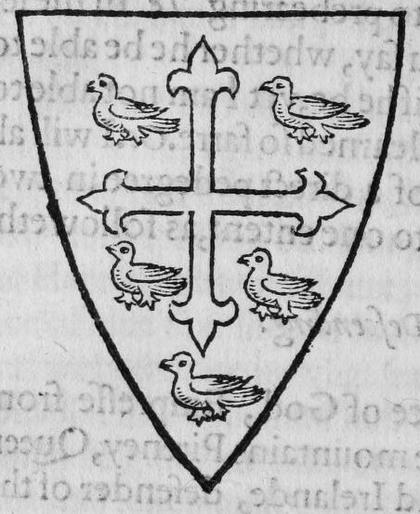 The field Iupiter, a crosse Potaẽce between v. Martelettes of the Sunne.
Ecclesiastes. Well is thee (O land) whose king is come of nobles.
Ascending.
King William the Conquerour, was Father to King Henrie the first. Father to Mauld the Empresse. Mother to king Henrie the second. Father to king Iohn. Father to king Henrie the third, Father to king Edward the first. Father to king Edward the second. Father to king Edward the third. Father to Lyonell Duke of Clareus. Father to Philip, married to Edmond Mortimer, Earle of March and Vlster. Father to Roger, Earle of March and Vlster. Father to Anne Countesse of March & Vlster, that married Richard, Earle of Cambridge. Father to Richard, Duke of Yorke. Father Fol. 118r Father to king Edward the fourth. Father to Elizabeth, that married king Henrie the seuenth, mother to king Henrie the viij. Father to the most high and mightie Princes, and our most dread soueraigne the Queenes Maiestie that now is, of whom I praie God, if it be his will, to send some fruite, as well to the comfort of her Maiestie, as to the great ioy of all her subiectes, and stable surety of this Realme. But ere you depart, as I first began with a shielde of antiquitie, worthilie borne of olde, for honors sake: so will I ende like-wise with a famous Scocheon of renowne, whose first bearing, did wholy spring of the former cause.
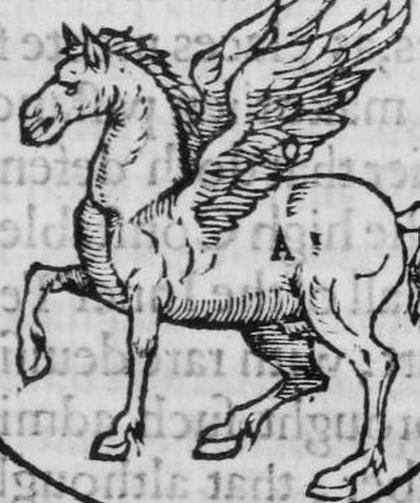 He beareath Azure, a Pega-sus argent, called the horse of honor whose condition _Sorares_ the xxiiij. Emperor of Assiria honored so much for his swift course, as hee iudged him not framed of the grosse masse of cõmon horses. And therefore _S. Gesserie Chaucer_ built vnto him (after of his owne na-ture and condition, a house called Fame, a place meete for the horse of honour) whose originall the Poetes faine was, when valiant _Perseus_ the Soul-dior of the goddes _Pallas_, in dangerous fight atchi-ued by helpe of her glittering shielde, the battaile against _Medusa_, the daughter of King _Phorcius_, who Fol. 118v who when he had seuered the head of this ougelie monster, straight gusht out the stremes of bloud in such abundance, as thereof grewe the flying horsse, to shew foorth the same of so happie a conquest: who taking flight towardes the heauens (where hee is now fixed) strake with his feete, the highest toppe of Mount Helicon, from whence immediatlie rose the fountaine (_Hypocrene_) wherein the Muses take their delight and bathe. Which fountaine sithence in all ages, hath suffici-entlie watered the growing plantes of the plea-sant Countries adioyning. And lately, so with cleare streames hath abounded, as exceeding the olde limitites burst foorth the bankes, reaching themselues to Countries farther distance, sweetelie moysting the soyles thereof. And amongest other, pleasantlie washt ouer the olde forworne Temples, dedicate to Goddes, as places meete for Pallas Muses, to inhabite and make their pastance: where now is placed a Souldier that doth defende the same, named _Pallaphilos_ the high Constable of the Goddesse her selfe, Marshall of the Inner Tem-ple, whose magnificent Court, with rare deuising of the Gods them-selues, brought such admira-tion to heapes of ruder number, that although I might see it, yet coulde I not approche it by the length of _Strabos_ kenning, when from farre he saw the nauie of _Puny_. And therein I thought me in _Tantalus_ paine, to swim in so sweet dewes on eue-rie side, yet notable once to assay thereof. **Le.** I haue heard you aptly discrie this horsse, wherein I com-mend your compendious instruction.