The beasts
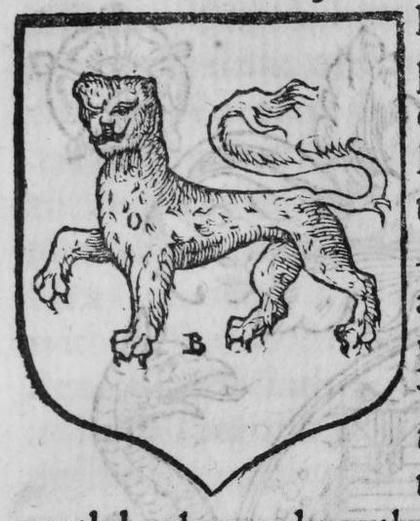 He beareth _Azure_, a Leopard passaunt Or. He is so called, because hee is vnkindly begotten, between the Liones and the Perde. _Isidore_ writeth that hee is a bloud-thirstie beast, and pursueth his praie leaping, which if hee cannot get at the thirde or fourth leape, then for indignation hee goeth backewarde, as though hee were ouercome. _Aristotle_ affirmeth, that hee is like the Lyon in all parts saue the head, and is of colour sported. _Homer_ saith, he beareth a grudgve vnto the Lyon, and hurtheth him by policie. _Auicene_ saieth, that when hee is sicke, he cureth himselfe by the bloud of the wilde gote whom he swiftly pursueth.
And here take with you two rules, All beastes of fearce nature, shall be taken in blazon onely, to the best intent, that is to say, to the most worship of him that beareth them. An other is this, when you tell of their clawes, you shall terme them enarmed, For their clawes are their defence. Here also is to be noted, that Lyons, Beares, Wolfes, Foxes, and all other beastes of rauening kinde, when they eate are called raping, and you must tell whereon. Now according to my promise, I will shew vnto you the second acheuement of the foure, which I spake of. This is the achiuement of a Baron, & of such a one, as is woorthie to be had in remembrance after his hence departure.
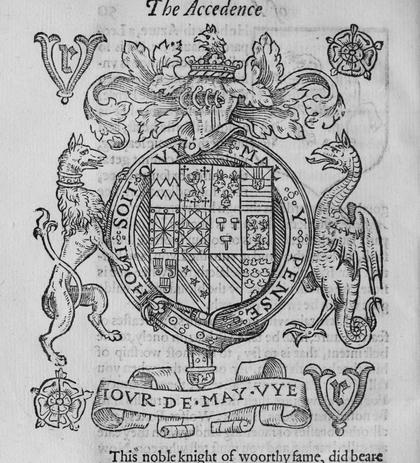
This noble knight of woorthy fame, did beare twelue seuerall cotes. The first whereof is Argent, a Fesse danse, Sable, by the name of West. The second Geules, crusule botone Fitch, a Lyon rampande, Argent, by the name of Lawarre. The third is Fol. 51r is Azure, three Leopardes heads iefaint Flowers Or, by the name of Cantelupe. The fourth, Barr-waies of vj. peeces, Or, and Azure, a chiefe of the first three pallets, between two base Esquiers Dexter, and Sinister, of the second an Insccocheon Ermine, by the name of Mortimer of Wigmore. The fift a Geronee of xij. pieces, Argent, and Geules, within a bordure Sable bezaunt, by the name of Peuerell. The sixth, Geules, Masculy verray, by the name of Tregose. The seventh, Argent, three Formales Geules, by the name of Forte. The eight Geules, three Lions rampande Or, within a bordure engrailed Argent, by the name of Fitzperse. The ninth Geules, three Sufflues Or, by the name of Verst. The tenth, Argent on a bende, betweene two bendelets Geules, three Mallets Or, persed by the name of Hakelet. The eleuenth Geules, a bend and two bendes aboue, Or, by the name of Grisley. The twelueth Verte, tenne Escalloppes, Argent iiij. iij. ij. and j. by the name of Thorley, all within the Garter. His creast, a Griffons head Azure, becked, berded, and eared within a Crowne Or, set on a Torte Geules, and Azure, mantelled Azure, doubled Ermine, supported with a Mantiger Argent, gorged erased Sable, with a coller Or, and a wyuerne Or, scaled Azure. His badge was a Crampette Or, giuen to his auncesters, for taking the French king in felde. Also his cognisance was a Rose parted in pale Argent, and Geules, which he had of the Mortimer aforefayd. Thus haue I blazed this noble mans Acheuement, by the name of sir Thomas West, baron of Grisley, Lord Fol. 51v Lorde Lawarre, and of Cantelupe, knight of the most honorable order of the garter. This I say, (the due honour faued in this point to the honourable) I thinke he was as true a knight, as since the first foundation thereof any hath bin. After whose decease, it pleased that good Lorde Morley, to make this Epitaph of him.
Vertue, honestie, liberalitie, and grace, And true religion, this seelie graue doth hold, I do wish that all our great men would, In good follow this noble barons trace, That from his wife hart did alwaies chase, Enuie and malice, and sought of yoong and olde, Loue and fauour, that passeth stone and gold, Vnto a worthie man, a rich purchase. These waies he vsed, and obtained thereby, Good fame of all men aswell far off, as me. And now is ioyfull in that celestial sphere, Where with Saints he sings vncessantlie. Holie honor, praise and glorie, Giue to God, that gaue him such might To liue so nobly, and come to that delight.
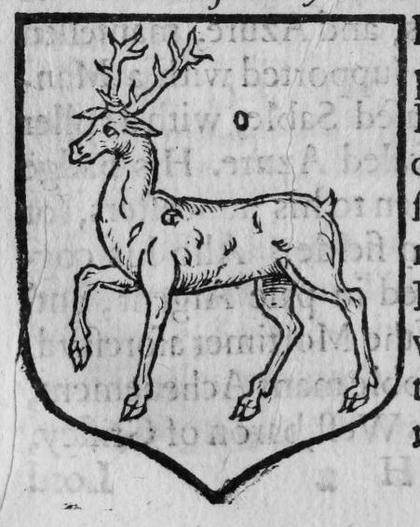 He bereth _Or_, a Hart tripping _Geules_. If you should haue occasion to tel of his hornes, you shoulde saie, he were attyred, and so likewise of the Bucke, and they are both vnged. The Hart is a worthy beast, and of light hearing. _Isidore_ saith, that whẽ he Fol. 52r he goeth to fight, hee froseth his hornes to make them sharpe. If he be put to flight, he swimmeth to his great aduantage. He delighteth much in musick, and when he feeleth himselfe too fatte, he seeketh dennes and lurking places, for feare of being chafed. If he be chased he looketh off backward. He renueth his attire euerie yere, and when he casteth his right horne he hideth the same. They keep commonly in herdes and helpe friendly the one the other. _Auicene_ saith, he is neuer troubled with feuers, because he hath no gall. He hath a bone in his hart, as pretious as yuorie. He feareth much the voice of the Foxe, and hateth the Serpent, He is long liued. For _Aristotle_ writeth, that _Diomedes_ did consecrate a Hart to _Diana_, with a coller of golde about his necke, which had these wordes. (_Diomedes Dianæ_) After whose time, almost a thousand yeres, _Agathocles_ the king of Sicile did kill the same Hart, and offered him vp with his coller to _Iupiter_ in his temple, which was in _Calabria_.
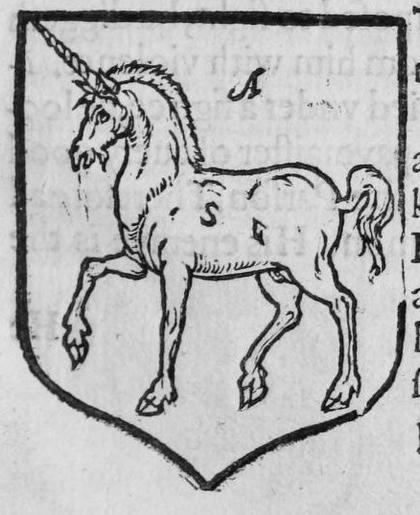 The field is _Argent_, an Vnicorne tripping _Sable_. This is a strong beast, as appeareth by that is spoken in Numery. God is to _Iacob_, as the strength of an Vnicorne. When he is hunted he is not taken by strength, but only by this policy.
Fol. 52v A Maid is set where he haunteth, and shee openeth her lap, to whom the Vnicorne, as seeking rescue from the force of the hunter, yeeldeth his head, and leaueth all his fiercenes, and resting himselfe vnder her protection, fleepeth vntill he is taken and slaine. His proper colour is bay. He hath in his head onelie one horne, whereof he taketh his name. It is vertuous against venime, and is most truely called yuerie. Isidore saith, the Vnicorne is cruell, and mortall enemie to the Olephant.
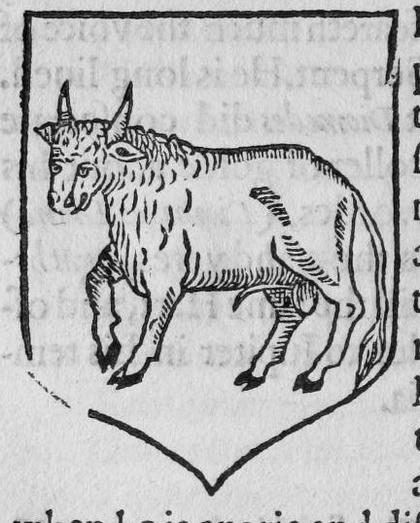 Hee beareth _Sable_, a Bull passant Or. This is a beast that is strõg in fight, whose strength is mightilie in his necke, he is proud of mind and hed-strong. _Plinie_ writeth, that by the countenance of a Bull, you may know hir sternesse, or gentlenes. All his threatnings are with his forefeete. For when he is angrie and disposed to fight, he diggeth the earth, and casteth it from him with violence. _Isidore_ saieth, when he is tied vnder a figtree, he looseth all his strength, He is paymaister of euerie good towne, and beneficiall to the Parson. Therefore all seuerals are to him common, His enemy e is the Rauen.
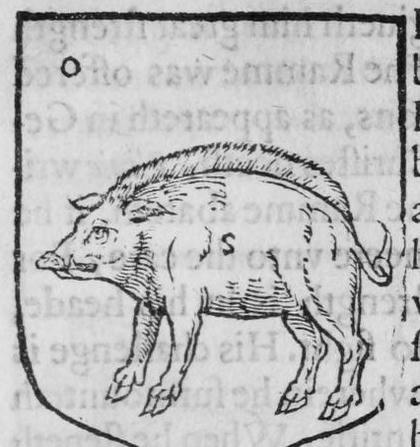 He beareth _Or_, a Bore _Sable_, The Bore is the right Esquire, for hee beareth both Armour and shielde and fighteth sternly. When he determineth to fight, he will frot his left shield, the space of halfe a day, against an oke because that when he is stroken thereon, with the tuske of his enemy, he shall feele no griefe thereof. And when they haue fought one day together, then they will depart of themselues keeping good appointment, to meet in the same place the next day after, yea, and the third day til one of thẽ be victor. _Auicene_ writeth, that the Bore is fierce and cruel, & setteth not by death. And though he be striken with a deadly wound, his couragious stomack, & yreful hart wil not let him flee, til either he kill or be killed. The Bore of nature is giuen much to the lust of the flesh. But this my Bore is chast, for my cutter hath cut him as short, as _Geff. Plantagenet_ Eaile of Bullein, cut the Bishop of Sagre, because he would haue him vse abstinence.
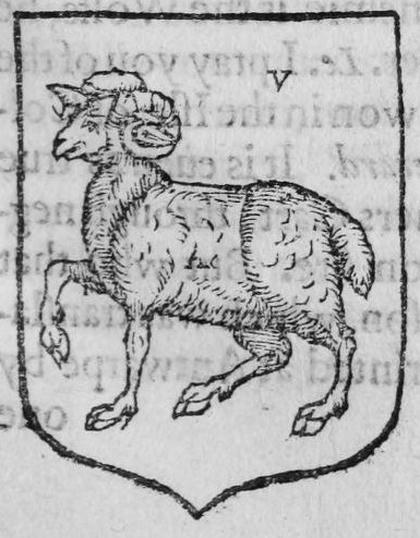 Hee beareth _Azure_ a Ram _Argent_. The Ramme saith _Isidore_, is a beast pleasing in hart, and milde by kinde and of authoritie hee is a Duke. For he hath the leadinge of multitudes and flockes of his owne kinde. Fol. 53v Therefore saieth he, kind giueth him great strength passing all other sheepe. The Ramme was offered vpon alters amongest nations, as appeareth in Genesis, to bee a figure of Christes death. _Plinie_ writeth, that the crueltie of the Ramme abateth, if he bee persed in the horne neere vnto the eare. For the chiefest part of his strength is in his heade, where hee is well armed to fight. His challenge is certaine courses at iustes, wherein he surmounteth all other beastes of his quantitie. When he fleepeth he holdeth vp his heade, and from spring time till haruest, he lyeth on the one side, and from haruest till spring time againe, on the other side. He is honorable, for when he leaueth his winter garment, there are xv. sundrie housholders that haue their liuing thereby. The which xv. doe finde sixe times xv, at the least. Hee is an auncient, of that honorable company of Drapers, of whom I am one, both by birth and seruice. But thereof am I nowe at large for that I coulde not support the custome of the famous _Cirie_, to stande in daunger of the lawes of this Realme. And nowe in commendation of the Ram, I saye to you there is nothing in him, vpon him, or that commeth from him, but it is both good and holesome. His enemie is the Wolfe, he feareth nothing but thunder. **Le.** I pray you of the golden Ramme, that _Iason_ won in the Isle of Colchos, is that of trueth? **Gerard.** It is euen as true as _Phaeton_ leading his fathers Cart, through negligence, set all the worlde on fire. But who that shall reade the historie of _Iason_, which was translated out of Frenche, and printed at Antwarpe by one Fol. 54r one of my name, if he be a Philosopher, he shal perceiue the meaning thereof: else let him reade Nor-ton and Ripley, who will learne him to vnderstand that historie, and so I end of the Ram.
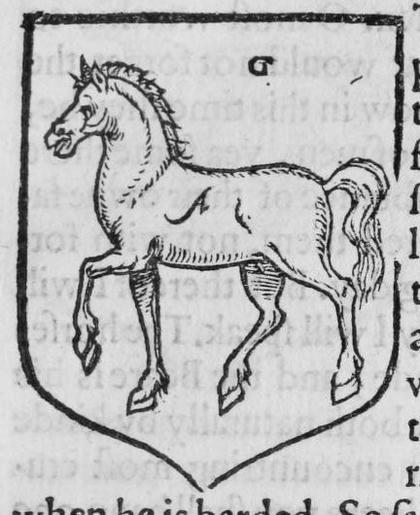 The field is _Geuls_, a horse passant _Argent_. _Isidore_ writeth, that the horse is comfortable in the field, and smelleth battail, & is greatlie encouraged thereto, by the noyse of Trompettes, and hath a desire to fight with his enemie. _Plinie_ writeth, that hee is proude of rich apparel, and especially when he is barded. So saieth the Prophet _Ioell_ to the Iewes, telling thẽ of their enemies on this wife. They are (saith he) to looke vpon like barded horse. Some horse wil not suffer any man to ride on him, but his onelie Lorde, _Bucephalus_ the horse of the great king _Alexander_, in battaile, woulde suffer no man to come on his backe, but onelie the King. And being fore wounded, would not suffer him to depart from him and take another horse, but wonderfully continued out the battaile, with his feete beating downe, and his Teeth biting, he destroyed manie enemies. Wherefore _Alexander_ after the horse was flain, made in the remembrance of him a Citie, in the countrey of India, and called it _Bucephala_. What wonderfull enterprises did _Iulius Cesar_ achieue, by the helpe of his horse, the which had Fol. 54v had his fore-feete like to the feete of a man, as _Plinie_ writeth. The horse _Arundell_ of no little fame in Britain land, amongst these, is woorthy to be remembred, for whose good seruice, the old renouned _Beauice of South-hampton_, builded the Castle of _Arundell_ in Southsex. O most worthie to be put in fames booke, that would not forget the seruice of a beast, where now in this time they be, that doe forget the seruice of men, yea some there bee, that make no remembrance of their owne fathers, who tenderly fostered them, not with forgetfulnes vnto their dying day. But thereof I will thinke more, then presently I will speak. The horses friende is the Grey-hounde, and the Beare is his mortall enemie, which in both naturally by kinde is planted, as at their first encountring most cruelly fight together. And heere you shall haue one rule, you shall not set forth a beast in Armes, to do any thing against his kind, as a horse to rampe.
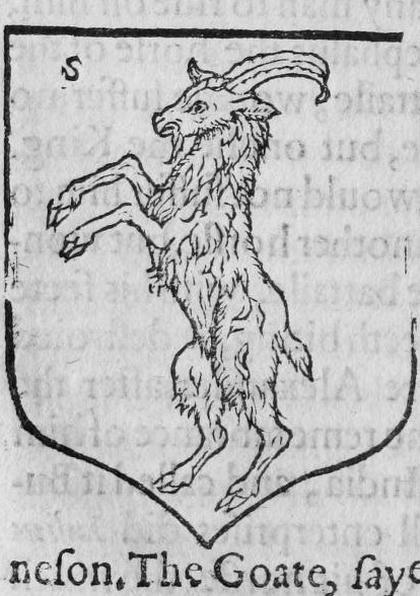 He beareth _Sable_, a Goate saliant _Argent_, Armed _Or_. The Goate in his fight, is not so hardie as politique. He defendeth with the fore feete, and cutteth with his hinder feete. There is no beast of heavy substance, that will climbe like vnto him. _Salomon_ putteth the Goat in the number of veneson, The Goate, sayeth _Isidore_, is verie venerous, but Fol. 55r but fighteth not therefore. The Diamonde, which neither iron or fier wil daunt, the bloud of the gote softneth, to the breaking.
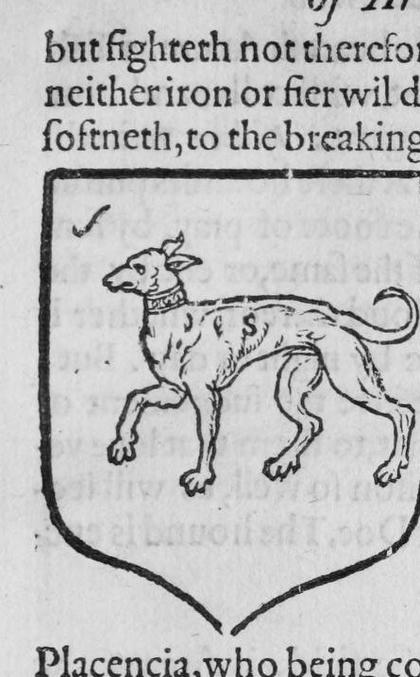 The field is argent, a Grei-hound passant, _Sable_. The hounde saith _Isidore_, knoweth eis owne name. _Plinie_ writeth that amõgst beastes, the hound is gratious and loueth his mai-ster, and putteth himselfe wilfully in peril in the de-sense of him, as appeared by _Celius_ the Senator of Placencia, who being compassed, & beset with mẽ of armes, was defended by a hound, and was not ouercome, vntill the said hound was slaine. In the like maner when _Iason_ was slaine, his hound would not go from the dead carcas, neither eat any thing but died also. But the hounde of _Sabinus_, is to bee wondred at, who forsooke not his maister, either in prison or death: but abode continuallye with the dead bodie with most dolefull noise. And when one gaue vnto the sayd hounde meate, the hound tooke the same and put to his maisters mouth, and would haue had his dead maister eaten thereof. And further, when the dead bodie of his Maister was throwne into the riuer _Tiber_, the hound leapt after, and swimming inforced himselfe to hold vppe the dead bodie of his late Maister, vntill both sanke vn-der the water. There are diuers kinds of hounds, of which I purpose not to speake of.
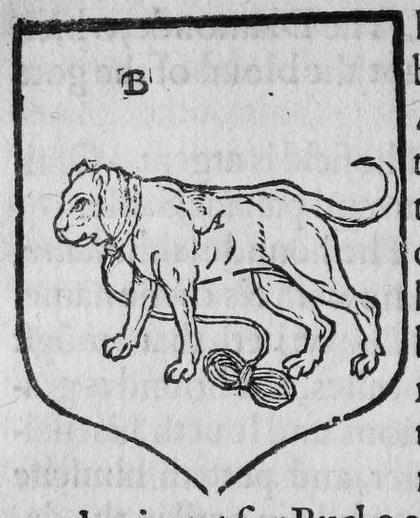 He beareath _Azure_, a Talbot with coller and Line _Argent_. _Isidore_ writeth, that these houndes pursue the foote of pray, by sent of the same, or else by the bloud thereof, whether it be by night or day. But I referre the iudgement of that, to them that loue veneson so well, as will ieo-parde a ioynt for Bucke or Doe, The hound is ene-mie to the Catte.
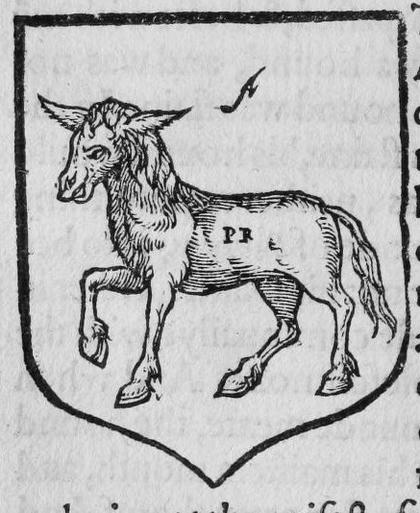 The fielde is _Argent_, an Asse passaunt in his proper colour. As it appeareth in the olde Law, the Asse to be ancien ter in the seruice of man, then the horse: So the Hebrew Rabbines do appoint the Asse to be stã-darde of the Tribe of _Isa-car_. Although the Asse be flowe, yet is he sure. And as he is not the wisest, so is he least sumptuous, especially in his diet. For his feeding is on Thistles, Nettles, and Briers, and therefore small birdes hate him, especially the sparrow is most enemie vnto him. I could write much of this beast, but that it would bee thought it were to mine owne glorie. Yet thus much shall I saye, that it pleased the high God, Fol. 56r God, by his secrete iudgement that amonge all beastes on the earth, the feelý Asse, with the toyl-full Oxe, should bee witnesses of his deare Sonne Christes birth, who neuer rode on other beast, but on the simple Asse, & her Colt. For these reasons therefore, I may conclude, the Asse not to bee vn-worthie to be borne in armes.
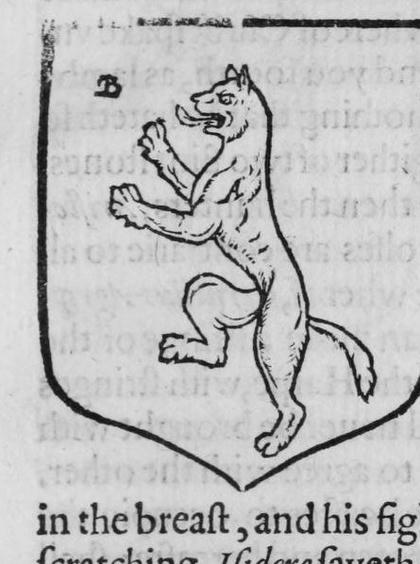 The field is azure, a wolfe Saliaunt, _Argent_. This, as the Hebrew Rabbines say, writing vpon the second of Numery, is the standard of the tribe of _Beniamin_. For _Iacob_ said, _Beniamin_ shall trauaile as a Wolfe. This rauenous beast is enemy as well to man as beast. He is strong in the breast, and his fight is both with byting and scratching. _Isidore_ sayeth, that what he vseth to tread on it prospereth not. It is said, if a man bee seene of him first, the man leefeth his voice. But if the Wolfe bee seene of the man first, then the Wolfe leeleth his boldnesse and hardinesse. _Plinie_ writeth, he loueth to plaie with a child, and that he will not hurt it till he be extreme hungrie, what time he will not space to deuour it. _Homer_ saith, that the Wolfe watcheth much, and feareth fire and stones, to bee whirled at him. _Auicene_ telleth, that hee desireth greatly to eate fish, And _Phiseologus_ writeth, that he may not bend his necke backward, in no moneth of Fol. 56v of the yere but in May. When hee seeketh his pray by night, he goeth against the winde. If any of his feete with treading of stones doo make any noyse: that foote hee byteth as chastising it. _Solinus_ shew-eth, that he beareth in his taile a locke of haire, that exciteth loue, which hee byteth awaie with his teeth, when hee feareth to be taken. He infesteth the wooll of sheepe that he biteth, and is aduersarie to them and their lambes, whereof Christ spake vn-to his Apostles, saying, I send you foorth, as lambs among Wolfes. There is nothing that he hateth so much, as the knocking together of two flint stones, the which he feareth more then the hunters. _Aristo-tle_ saieth, that all kind of wolfes are contrarie to all kinde of sheepe. For proofe whereof, _Cornelius Agrippa_ also affirmeth that if a man make a stringe of the wolfes guts, and put it on the Harpe, with stringes made of sheepe s guts, it wil neuer be brought with any consent of harmony, to agree with the other. And here I ende, of onelie beastes to occupie the fielde. But where I haue written and hereafter shall of enmitie betweene beast and beast, or otherwise I pray you take it, as a good Herehaught shoulde doo, that is, to the best intent. For I follow the au-thours, whome I haue alledged, wherein I will you not vainely to weigh deceitfull prophesies, bufilic searching, who giueth that beast, or who beareth this. For if it were lawfull for mee to write of that: I coulde by reason perswade you, that they are all doone and past, and that there is nothing of them to be looked for, but for the comming of Christ in his glorie, Which as _Iob_ sayeth, I hope to see in this my Fol. 57r my flesh. **Le.** Sir, I trust I am voyde of any of these suspitions, I seeke nothing, but onely to be a good Herehaught. Wherefore as you haue begun with me, so I pray you continue to the ende. **Ge.** Well, for your further instructions, I will goe forwarde.
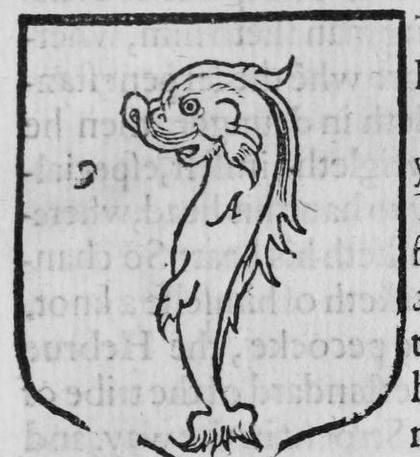 The fielde here is _Sable_, a Dolphin hariant, _Argent_. If it were in Fesse, then you shoulde say, nayant. This is called the prince of fishes, and for his strength and bignes, excelleth all o-ther. For as authors write, hee is not enscamed with much fatnesse, but is all of muscles and senues, wher-by his might is doubled. Hee is a ruler of other, that seeme stronger then himselfe. By him the mari-ners know, when they shall haue tempest, especi-allie when they see him reioice, with shewing him-selfe aboue the water. Here you shall learne a rule, that is, when any fishe is vpright as this is, ye must terme it hariant. Also, when they are eating, you shall call it deuowring, and tell whereon, because thy swallow all whole.
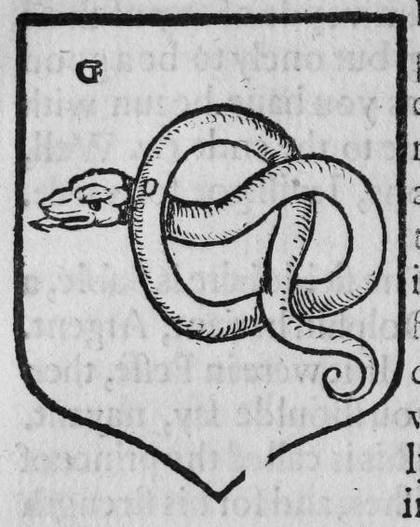 He beareath _Geules_, a Ser-pent nowe, _Or_. _Dioscorides_ saith, The Serpent seareth & flieth a naked man, and leapeth on a mã cloa-thed. The spittle of a fast-ing man flieth him, wher-fore whẽ the serpent stan-deth in daunger, then he wrigleth himselfe, especial-ly to haue his head, where-in lieth his heart, So chanceth it sometime, that he maketh of himselfe a knot, The Serpents enemie is the pecocke, the Hebrue Rabbies name this to be the standard of the tribe of _Dan_, saying, _Dan_ shall be a Serpent in the way, and an adder in the path, byting the horse-heeles. Of the Serpent I could write much more, but this I thinke is sufficient. **Le.** I beseech you now shew me some other of the acheuements you promised. **Ge.** I will shewe vnte you the acheuement of the knight, which is the third.
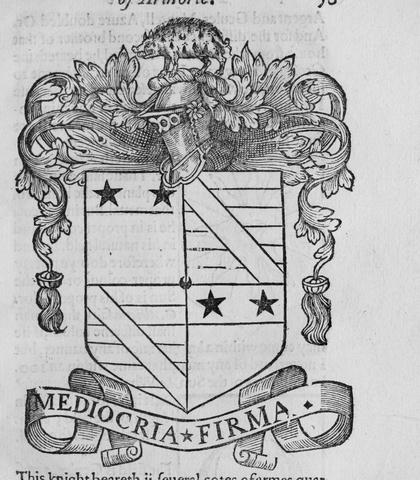
This knight beareth ij. seuerall cotes of armes quar-terly as followeth. The first, the field is Geules on a chiefe Argẽt, two Mullets Sable. The second bar-waies of sixe peeces, Or & Azure, a bende Geules. The thirde as the second. The fourth as the first. His creast a Boare passant Ermines, set on a wreath Argent Fol. 58v Argent and Geules, Mantell, Azure doubled Or. And for the difference of a second brother of that house, from whence he is descended, he beareth the Cressant. Now haue I one other atchieuement to shew you, the which I will deferre a while, because I will not tyre you with too much of one thing to-gether: therefore ye shall haue in the mean space some sundry cotes of blazon, as followeth.
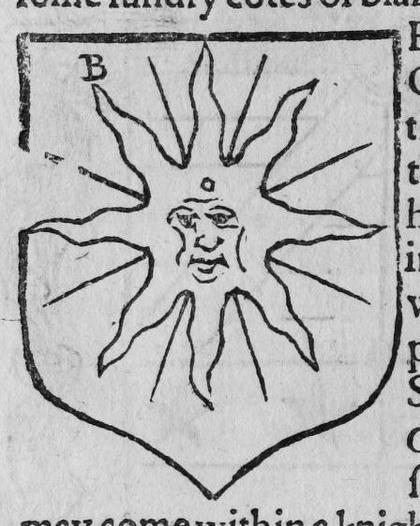 He beareth _Azure_ a Sun _Or_. I haue said enough of this planet in the blazon of that mettal, But in this cote he is in proper colour, and in his natural field. **Le.** And wherefore doo ye not say proper colour or that the Sun is of his proper color. **G.** _Alciatus_ saith that a man shall discerne colour, if he may come within a knights rase of any banner, but I neuer hard of any man, that came within an 100. knights rases of the Sun. **Le.** What is a knights rase? **Ge.** It is lx. foote of assise in length, of the field, and is of Herehaughts so called.
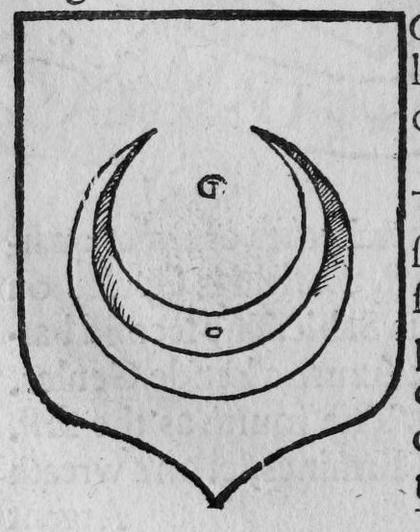 The field is _Geules_, a cressant _Or_. This is as much to say as the Moone in her prime, which is the thirde day after the coniunction, or as we commonly cal it, the new Moone.
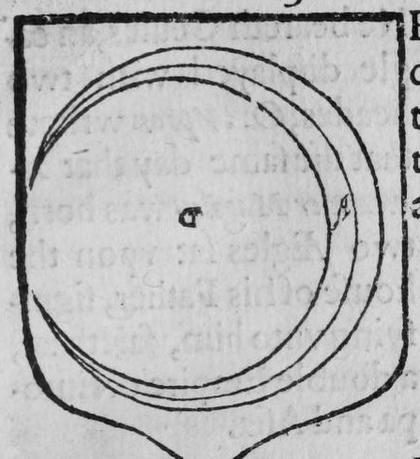 He beareth _Geules_, an in-cressant _Argent_, Which is the Moon from the prime till after the first quarter, and yet lacketh of the ful.
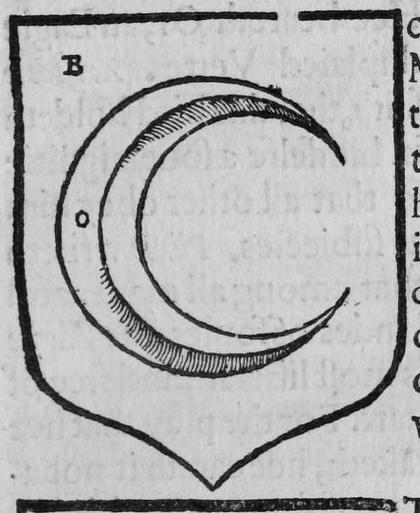 Hee beareth _Azure_, a de-cressant _Or_. Which is the Moone from the last quar-ter. This signifieth a man to do some thing, whereby he is aduanced to honour in his age, when al things decreaseth with him, wisdome only except, which commeth from the brain, whereof the Moone is lady.
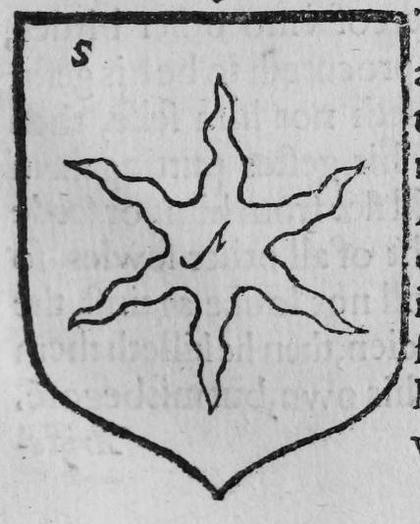 The field is _Sable_, a Starre argent, This is the pole ar-tike, who leadeth the ship-maister, and sheweth the Astronomer, the way to al other starres: such like star it was (saue that it was not fixed) that brought the iij. Magiciãs to honor Christ, where he was borne.
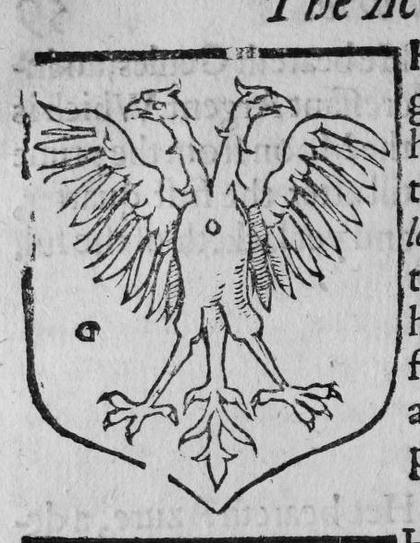 He beareath _Geules_, an ea-gle displayed with two heads, _Or_. _Vpton_ writeth that the same day that _A-lexander Magnus_ was born, two Aegles fat vpon the house of his Father, signifying vnto him, saieth he, a double Empire of Euro-pa and Asia.
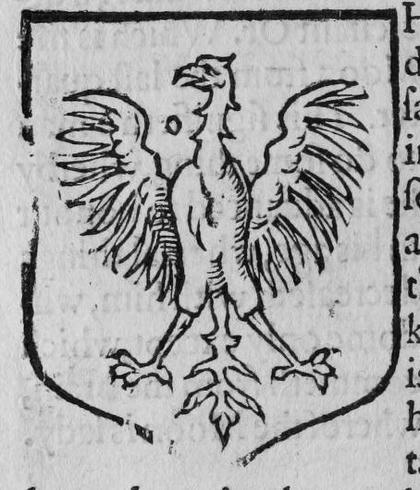 Hee beareth _Or_, an Eagle displaied _Verte_. _Aristotle_ saith, that this bird holdeth in himselfe a soueraignitie so that all other obey him as subiectes. _Plinie_ writeth that among all maner and kindes of foules, the Aegle is most liberall, and free of hart. For the pray that hee taketh, hee eateth it not a-lone, but giueth part thereof vnto other birdes, that follow him, whom he procureth to be his gests. But when that pray suffiseth not him selfe, then he is somewhat bolde of his gests putting them to choise, whether they will flee from him, or feede him. He is brightest of fight of all other sowles, so that if his young ones will not looke against the Sunne, without watering eien, then he killeth them thinking that they are not his own, but misbegotẽ, _Aristo-_Fol. 60r_Aristotle_ saieth, the Eagle hath foresight of the we-thers, and that day that he fleeth abrode, no hauke within his precinct will flee to any game.
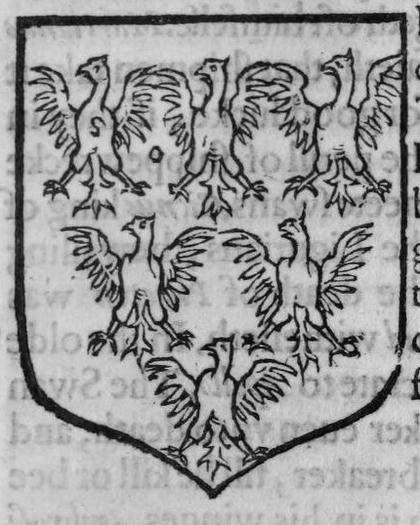 He beareth _Or_, vj. Eaglets displaied, _Sable_ iij. ij. & j. These may not bee called Eagles, because there may bee no more but one Eagle in one Escocheon. If there be mo, they are thus called, who are to be taken for yong Eagles.
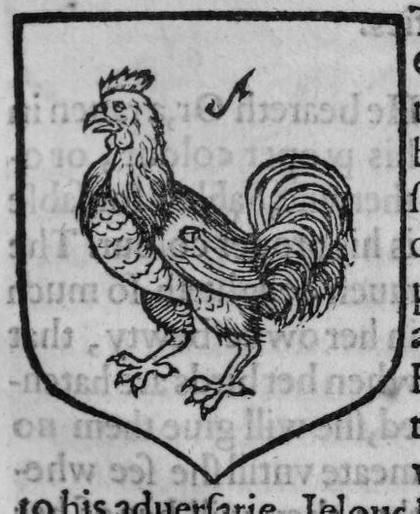 The field _Argent_ a Cocke _Geules_, _Plinie_ writeth that the Cocke is the royallest birde that is, and of him self a king, For nature hath crowned him with a perpetuall Diademe, to him and his posterity for euer. He is the valiantest in bat-taile of all birdes. For he will rather die, then yeeld to his aduersarie. Ielous he is in such fort, that he fighteth oft for his wiues, and loueth them so well as he bestoweth all that he may get on them.
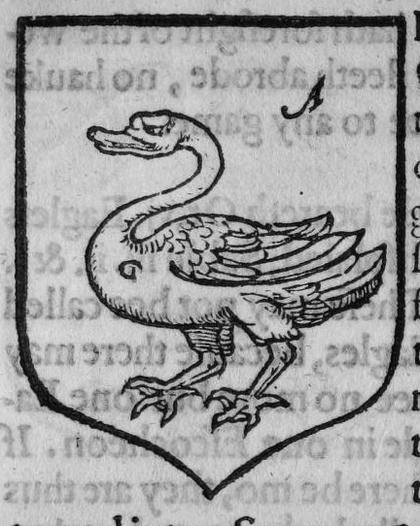 He beareath argent, a Swan _Geuls_. _Isidore_ writeth, that the Swan doth not onelie delight in Musick, but singeth of himselfe. _Martianus_ saieth, that shipmen take it for good lucke, if they in the perill of shippewrecke meete swans. _Cignus_ king of the Ligurians, bewailing the death of _Phaeton_ was turned into a Swan, as _Ouid_ witnesseth. In the olde time, this birde was consecrate to _Apollo_. The Swan pursueth the cockold-maker euen vnto death, and will not leaue the spouse breaker, till he kill or bee killed. His chiefe strength is in his winges _Ambrose_ saith that he singeth much before his death as reioising the end of all calamities.
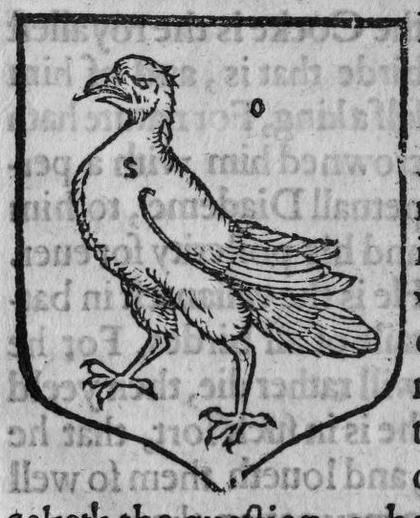 He beareth _Or_, a rauen in his proper colour, or otherwise, _Sable_: for sable is his proper colour. The rauen delighteth so much in her owne bewty, that when her birds are hatch-ed, she will giue them no meate vntill she see whe-ther they will bee of her owne colour, or no. _Iob_ asketh the question, who prouideth meate for the rauen?