The lion
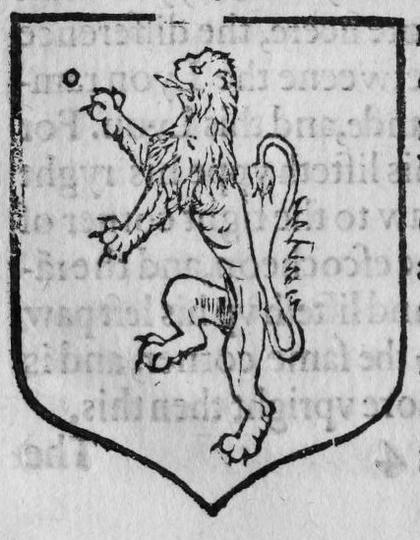
Now take some heede to the blazon of single cotes whereof Fol. 44r whereof I meane somewhat to treat, And to thintent that this our talke may the more luckier proceede: sithen of beasts I entend first to make mention, I purpose likewise to begin with the most honorablest, Le. Is there any beast of more honor thẽ other? Ge. All authors do affirme no lesse, and therein do meane especially the Lion, which I wil set vnto you of sundrie sorts, so as he is borne of diuers gentlemen. but first of all rampand, and thus hee is blazed.
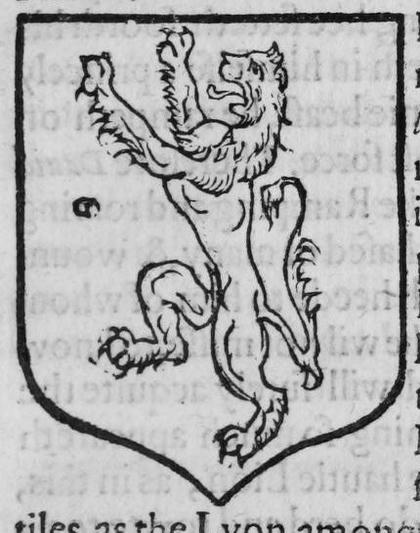 He beareth _Geuls_, a Lion rampand, _Argent_, _Nicholas Vpton_ writeth, that amongst all tokens of life in armes, the Lyon is to be preferred, because hee is king of al beasts. The same likewise appeareth, by that, which the Prophet _Micheas_ said, that _Iacob_ should be among the gentiles, as the Lyon amongst beasts, whose like comparison right well approueth the opinion of _Vpton_. But of the Lyon, a little I will write as by authoritie I haue learned the same. It is laide that when they are first Lionsed, they sleepe continually three long Egyptian daies. Whereat the Lion, making such terrible roring (as the earth trembleth therewith) raiseth them by force thereof out of that deadlie sleepe, ministring foode, which of sleepe, before they could not take. It is the Lions kinde not to hate man, except he be molested of him, His mercy like-Fol. 44vlikewise is such, as hee suffereth straungers to passe by him, especially such as haue bin in thraldome. _Plinie_ writeth of him, that he is ielous, for he punisheth the Lionesse his mate cruelly, if she yeelde her selfe vnto the lust of the Parde. The Lion, eating his fill but euerie third day (if he be in daunger to bee chafed) hee vometeth at his will, and lanketh himselfe. _Isidore_ saieth, when he is pursued he lurketh not, but in the plaine fielde abideth battell, and armeth himselfe to withstande his enemies. _Aristotle_ writeth that in his marching hee setteth foorth his right pawe first, and beareth in himselfe a princely port. When he pursueth anie beast, he rampeth on them, for then he is in most force. Therefore _Dauid_ saith, they gape vpon me like Ramping and roaring Lions. The Lyon being chased of many, & wounded but of one, giueth such heede to him of whom he receiueth the same that he wil not misse, to know from whence it came, and will surely acquite the giuer thereof. But in nothing so much appeareth the princely minde of the hautie Lion, as in this, that where other beastes do herd and rowte together, hauing amongst them Rulers, the Lion will not so doo, neither will hee haue any soueraigne, such is the haughtie courage of his high stomacke, that he accounteth himselfe without peere: when he is sicke, he healeth himselfe with the bloud of an Ape. In age when his strength faileth him, he becommeth enemie to man, and not before, but neuer to children, When the Lion is angry, first he beateth the earth, and then his owne back with his taile. He is so hot of complexion, that alwaies hee hath Fol. 45r hath the feuer quartaine. There is little marrow in his bones. For when they are smitten together, fier flieth out of them, as from a flint stone. Therefore in the olde time they made shields for horsemen of Lyons bones which sorts of shields, I my selfe haue one at this day, and do keepe the same, as a worthy antiquitie of elder age. The Lyon feareth nothing but fire. The crowing of a Cocke is the hatefulest noise that he may heere. The fight of whose combe greatly annoyeth him. Before he dieth he beateth the earth oft, and therewith, teares plentifully doo trickle from his eies. **Le.** Let me aske you one question, how manie do beare the Lion? For I thinke there can but nine beare the Lions rampand. **Ge.** Yes, there may aboue nine times nine beare the Lion in that maner. **Le.** I am answered, I pray you proceede, and teach me some other thing. **Ger.** I haue not yet done with the Lion. Wherefore I intend a little further to proceed therein.
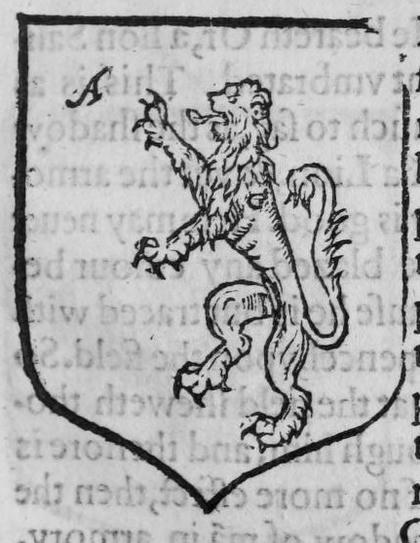 He beareth argent, a Lion saliant, _Geules_, you must note heere, the difference betweene the Lyon rampande, and this Lyon. For this lifteth vppe his ryght paw to the right corner of the escocheon, and the rampand lifteth vp his left paw to the same corner, and is more vpright then this.
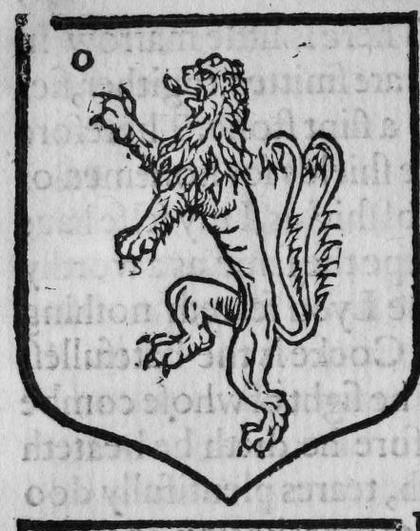 The field _Or_, a Lion Saliaunt, his taile forked, _Vert_. **L.** Is this difference enough from the other Lion, if the fields and Lions were both of one colour? **Ge.** Yea a lesse thing then this were difference enough, to beare a Cote vnchalenged.
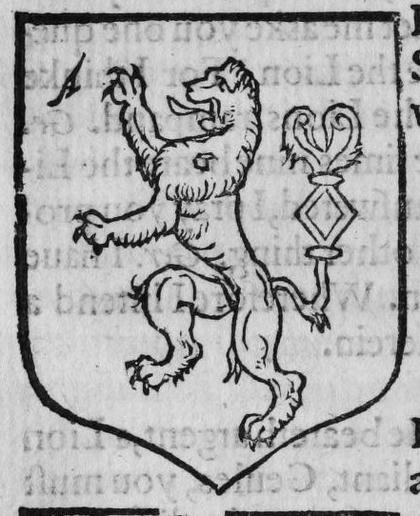 He beareth _Argent_ a Lion Saliaunt, his taile forke nowed _Geules_.
 He beareth _Or_, a lion Saliaunt vmbrated. This is as much to say, as the shadow of a Lion, & yet the armory is good. Here may neuer be blazed any colour because he is but traced with a pencel, vpon the field. So that the field sheweth thorough him, and therefore is of no more effect, then the shadow of mã in armory.
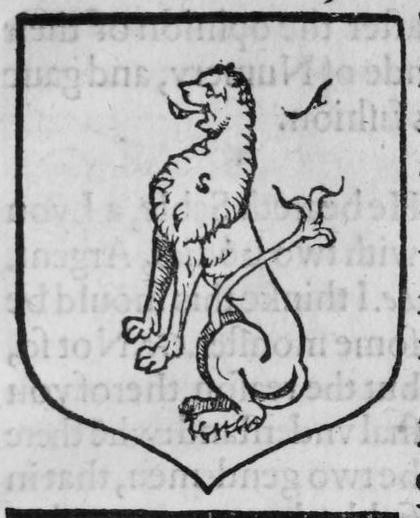 The field _Argent_, a Lyon seiaunt, _Sable_. Nowe hee is returned from his pray and taketh his rest, respecting his enemies. For when hee sitteth on this fashion, hee is not determined to flee.
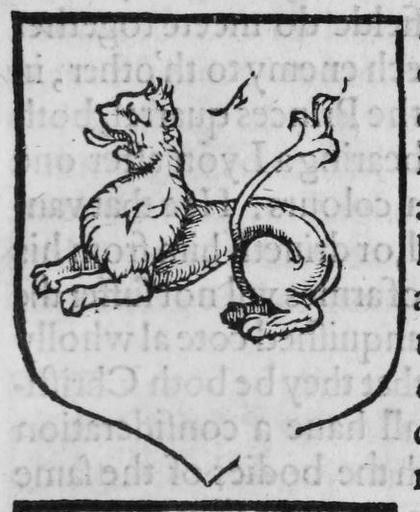 He beareth argent, a Lion couchaunt, _Verte_. The Lion may not be made to couch by force. But at his owne gentilnes. His nature is that at the correction of an other, hee will submit himselfe. As if a mã beate a dogge in the presence of the Liõ: then he coucheth on this maner. But to bee corrected himself he may not suffer it, but withstandeth it with force.
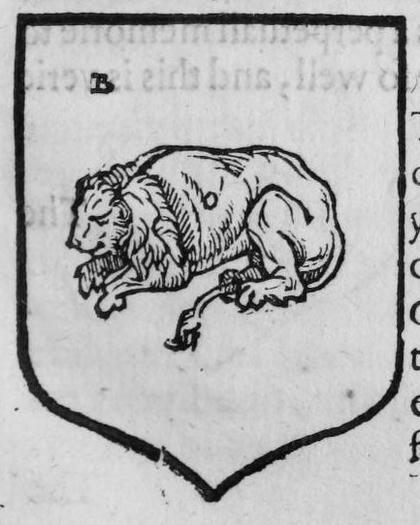 The field is _Azure_, a Lion dormant, _Or_. **Le.** Why do ye make him with his eies open & cal him dormant? **Ger.** Because _Isidore_ sayeth, their sleepe is not with close eyen. The Hebrewes set forth in banners, the armes of Fol. 46v of the children of Israel, after the opinion of their Rabbies, vpon the seconde of Numery, and gaue vnto _Iuda_, a Lyon in this fashion.
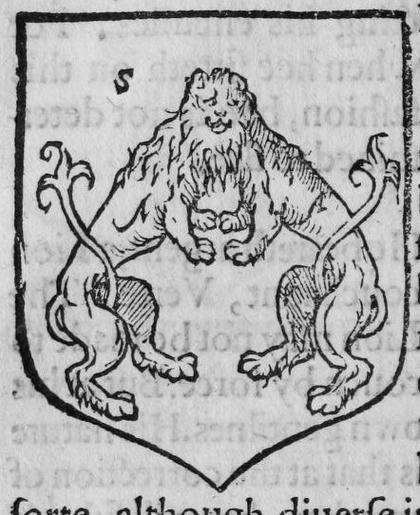 He beareth _Sable_, a Lyon with two bodies, _Argent_. **Le.** I thinke this should be some monster. **Ge.** Not so, but the reason thereof you shall vnderstand: whẽ there be two gentlemen, that in fielde do meete together ech enemy to th'other, in the Princes quarrel, both bearing a Lyon after one forte, although diuerse in colours. Hee that vanquisheth the other in field, or driueth him from his standerd, because the law of armes wil not suffer the vanquisher to beare the vanquished cote al wholly as his aduersarie did, for that they be both Christians, the Herehaught shall haue a consideration thereof, and shall put both the bodies of the same Lyons vnder one head, as a perpetuall memorie to him that serued his Prince so well, and this is verie good armorie.
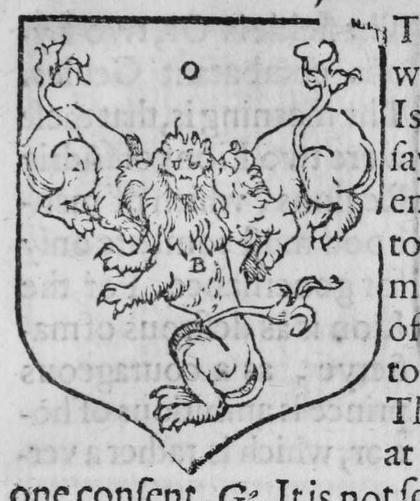 The fielde is _Or_, a Lyon with iij. bodies, _Azure_. **Le.** Is this good armory? **Ge.** I say to you, it is verie antient and lawful, and borne to a good meaning. As it might be, the agreement of so many, and thereupon to vse one consent. **Leigh.** That were to be marueled at, to see three Lions of one consent. **Ge.** It is not so much to be maruelled at, as to see iij. Lions and an Eagle all of one minde and consent. For _Otho_, the fourth Emperour of Almaine for the loue that he bare to _Richard_ the first, and _Iohn_ Kings of England, bare the armes of England, impaled with the armes of the Emperour, the kings being well content he should do so.
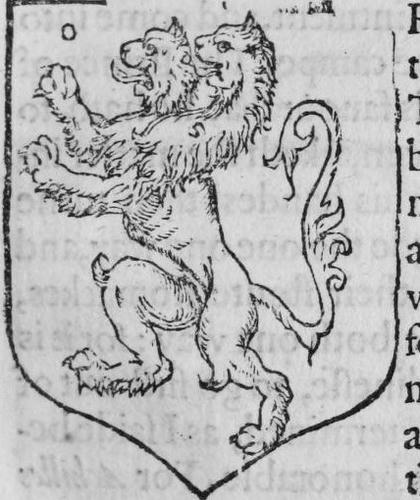 He beareth _Or_, a lion with two heads rampãd, azure. This betokeneth him that beareth the beast, to be homager to two such princes as do both bear the lions, which both are his heads, for that they tooke homage of him for such lãds as he holdeth of them, by that seruice.
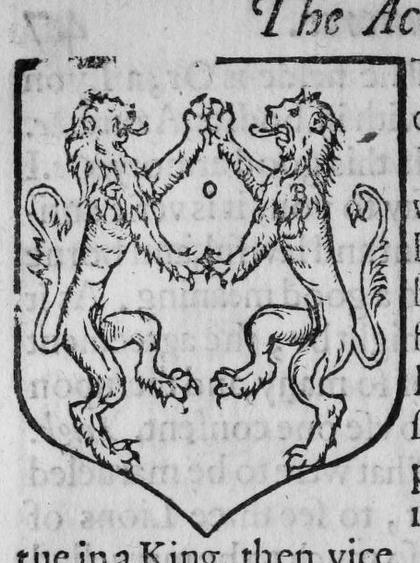 The fielde is _Or_, two Lyons combatant _Geules_. The meaning is, that these were two Lions of sũdrie Regions, which of manhood must combate only for gouernance. For the Lion is as desirous of masterye, as a courageous prince is ambitious of honor, which is rather a vertue in a King, then vice.
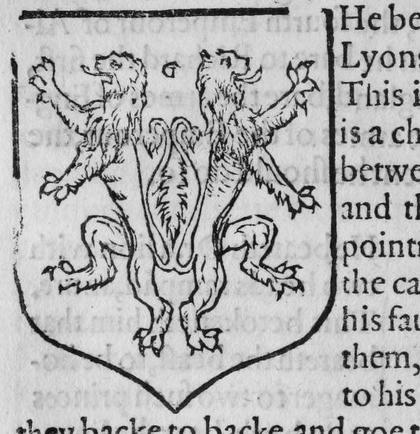 He beareth _Geules_, two Lyons endorsed, _Argent_. This is like as when there is a challenge of combat between two valiant men, and they keepe both appointment, and come into the campe. The Prince of his fauour that he hath to them, taketh the matter into his hands: then turne they backe to backe, and goe the one one way, and the other the other. For their stoute stomackes, will not suffer them to goe both one way: for it is counted an iniurie to hardinesse, to go first out of the field. Therefore is it determined, as I saide before. But for the cote, it is honorable. For _Achilles_ at the siege of Troy, bare _Azure_, two Lyons endorsed, _Or_.
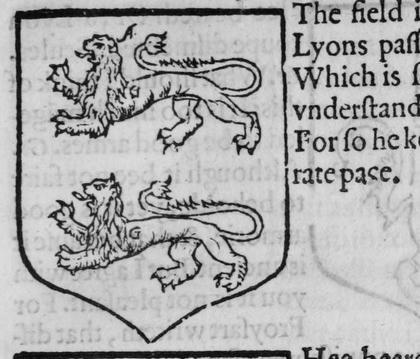 The field is _Argent_, two Lyons passaunt, _Geules_. Which is so much to bee vnderstood, as going. For so he keepeth a moderate pace.
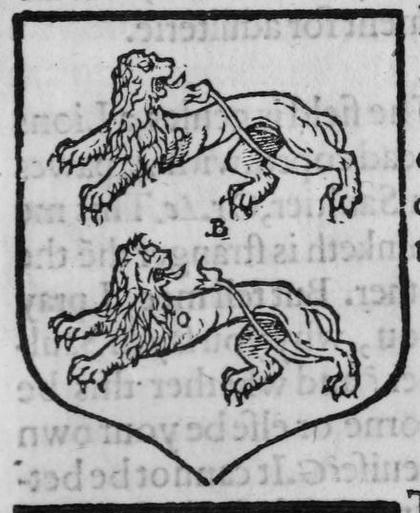 Hee beareth _Azure_ two Lions passant regardant, _Or_. Although these Lyons are contrarie to their quality, yet is it honorable to the bearer of them.
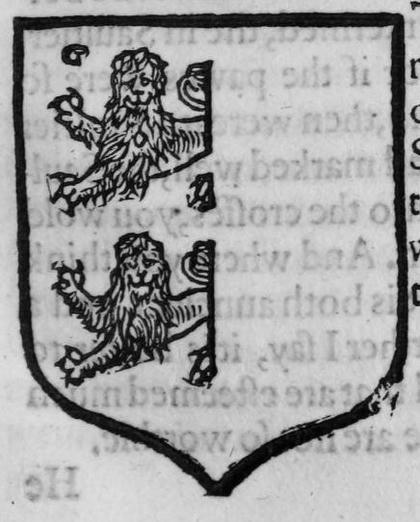 The field _Geules_ two demie Lyons passaunt, gardant, _Or_. Some haue thought that these Lions be regardant, whereof by proofe you see the contrarie.
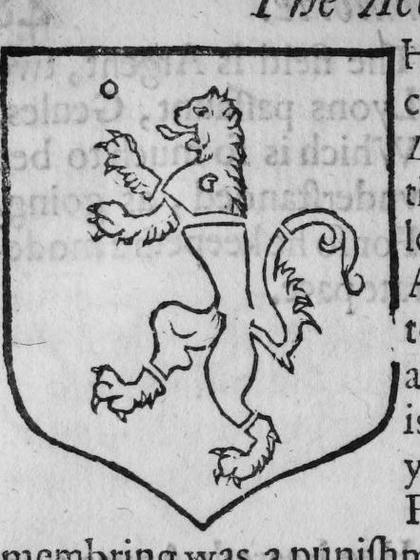 Hee beareth _Or_, a Lyon coupe dismembred, _Geules_. **Le.** What should I think of this? It is too much māgeled to be good armes. **G.** Although it bee not faire to beholde, yet it is good armorie, & that because it is ancient. But I agree with you it is not pleasant. For _Froysart_ writeth, that dismembring was a punishment for adulterie.
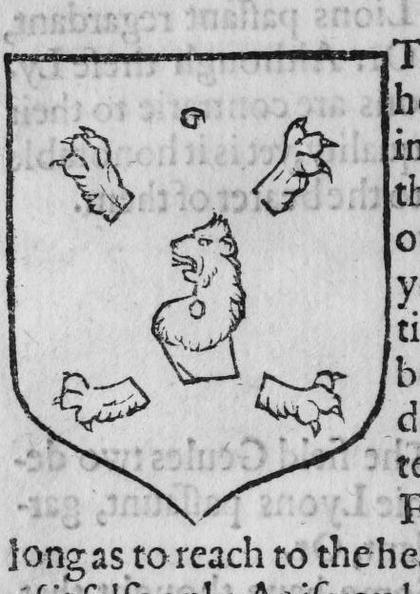 The field is geules, a Lions head coped, with 4. pawes in Saultier, _Or_. **Le.** This me thinketh is stranger thẽ the other. But tell mee, I pray you, why you say in Saultier? and whether this be borne, or else be your own deuise? **G.** It cannot be better termed, thẽ in Saultier. For if the pawes were so long as to reach to the head, then were it a Saultier of it selfe only. As if you had marked well, the Saultier I haue set forth next vnto the crosses, you would not haue asked the question. And where you think it my deuise, I say to you it is both auncient, and a Gentlemans cote. Yet further I say, it is better to be borne, then a thousand that are esteemed much better then it, and in deede are not so worthie.
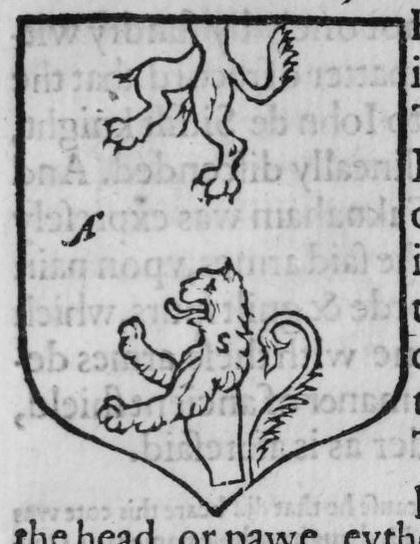 He beareth _Argent_, a Lyon iefant, and iefant _Sable_. **Le.** This I take to be two halfe Lyons. **Ge.** Not so, it is but one Lion. For if you marke it well, you shall perceiue that as he goeth out at the chiefe, so commeth he in, at the basse of the Escocheon. There is oftentimes some part of the Lyon borne, as the head, or pawe, eyther erased or couped, as by example hereafter shall followe.
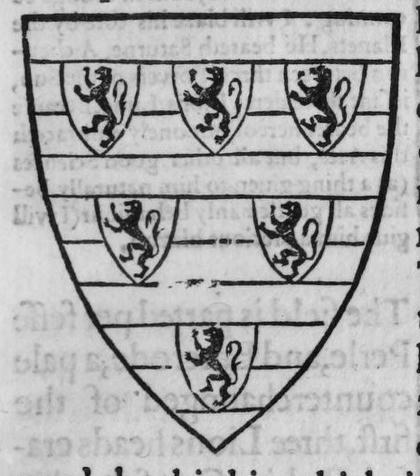 He beareth of ten barruley, _Argent_ and _Azure_, charged with sixe Escocheons _Sable_, theron as many Lyons of the first rãpand, langued _Geules_. This cote I haue set out to th'intent to shew you how the same was blazed in the seventh yeere of the raigne of king _Edward the third_, in which time there was a chalenge in the field of mount Holliton, betweene _Iohn Sitfilt_ Knight, and _William de Faknāham_, for the bearing of the same armes. And for that the king wold haue Iustice don in that case without shedding of bloud, he appointed two Iudges to haue the only hearing and determining of the said matter, whose names were _Edw. de Beaufle. & Io. de Mowbrey_: before whom the Fol. 49v the right was duly tried, not onely by sundry witnesses, but also by antient matter of record, that the said armes did belong vnto _Iohn de Sitfilt_ knight, as to him of antient time lineally discended. And therfore the said _William Faknaham_ was expresely forbidden the bearing of the said armes, vpon pain of forfaiting his sharpe sworde & guilt spurs, which determination is to be seene with these armes depicted in the margent in this maner of ancient shield, and blazed in the same order as is aforesaide.
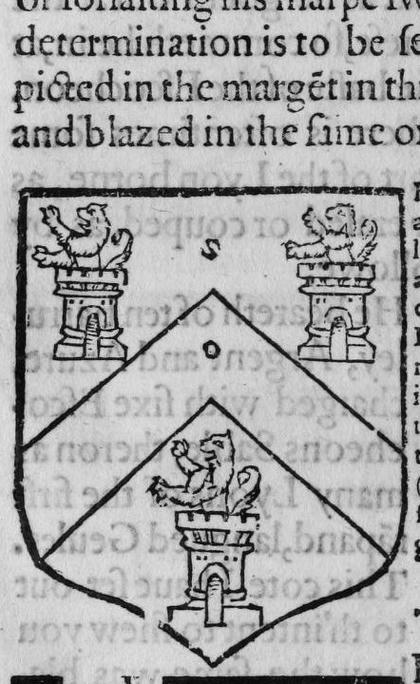 Because he that did beare this cote was an Herhaught, whose name was _Cailis_, and that by report, hee surmounted all other of his time, both in toongs & cunning: I will blaze his cote by the Planets. He beareth Saturne, A cheuron between three Towers of the Sun, iefant three demy Lions, Lune. Because the bearer hereof, not onely embraceth this Arte, but all other good Sciences (as a thing giuen to him naturally, besides all gentlemanly behauiour) I will giue him a precious blazon.
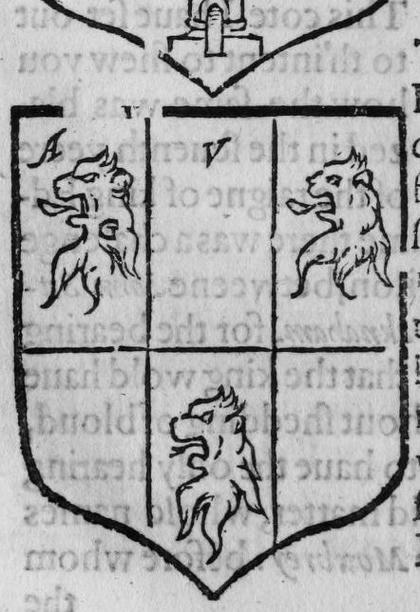 The field is parted per fesse Perle, and Emerode, a pale counterchaunged of the first, three Lions heads erased, Rubie. Consider that the Moone and Venus are the field, and howe Mars keepeth the same, who wil neuer flee. Thus ending with the Lyon, I will say some thing to you of the Leopard, as followeth.