The points and partitions
3 Fol. 24r You shall be mercifull to all people.
4 You shall do no harme to the poore.
5 You shall not tourne your backe to your enemies.
6 You shall holde promise, as well to friend as foe.
7 Ye shall keepe hospitalitie, especially to strangers.
8 You shall vphold maydens right.
9 You shall not see the widoes wronged.
Then Asteriall made to Olibion a Target of Oliue tree, with three corners, two aboue his face, and one benath to the groundward: in token that he was the chiefe of the bloud of the three sonnes of Noah. By the Oliue tree, hee vnderstoode to winne victorye. By the point of his target to the ground, his cursed brother Cain. By the right corner, Iapheth, by the left corner, Sem. And this is written for your learning. Le. Verily, it delighteth me much to heare it, & I can not be weary so long as you continue in this talke. Ge. I wil stay no longer therein, I haue said enough: else I shoulde begin of one thing, and make my booke of an other. And now before you enter into blazon, I will teach you to knowe your Escocheon, which containeth in it, nine sundrie points. And that as shall appeare, I will set foorth in three Escocheons, whereof this is the first.
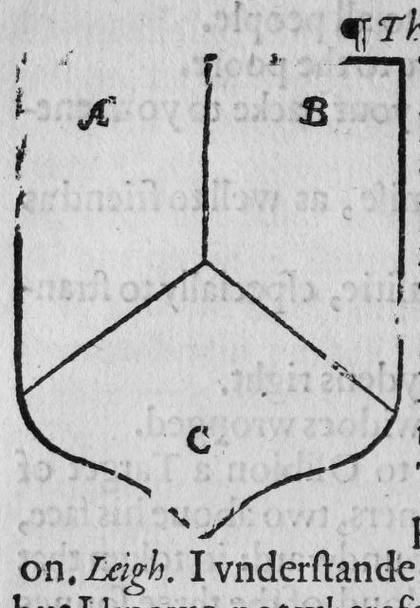 **The first.** This letter A, is the firste point of the Escocheon, and is called the dexter point, because it is on the right side of the Escocheon. The letter B, is called the sinister point of the same Escocheon, because it is in the left side of the same. The letter C, is the base point of the same Escheon. **Leigh.** I vnderstande you well of the pointes: but I knowe not wherefore, or to what purpose, I should neede to learne them. **Ger.** By that time ye haue practised, ye shall thinke it necessarie to know these seuerall pointes. For in some armes, especially in dutch arms, ye shal haue three sundry things occupie these three sundry points, Experience shall teach you this, when ye come to it, The second Escocheon hath other three points, as
The second.
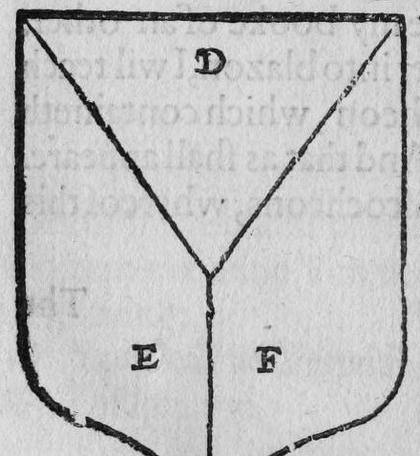 The letter D, is called the chiefe point. The letter E, must be takẽ for the dexter Base point, & the letter F, you must take for the Sinister base point. This I thinke sufficient for those. **Le.** I do perceiue by this, that somtime it wil so be, as one only thing or tokẽ, shalbe Fol. 25r shalbe vpon one of these partes of the Scocheon, that shall not be else-where.
The third.
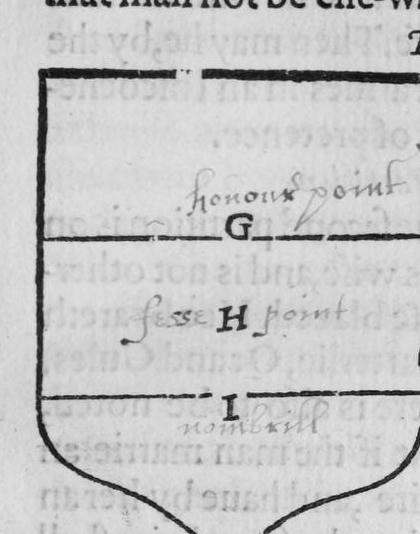 **G.** Ye haue said, And now I will shewe you of the iij. last points, as on this wise. The letter G, of all places of the scocheon, standeth in the most honourablest, & is called the honor point The letter H. is termed the Fesse point, The letter I, is called the nombnil. For it is euen opposite to the nauel. Thus I haue shewed you, for these ix. pointes. Now wil I declare to you, of ix, sundry partitions.
The first partition.
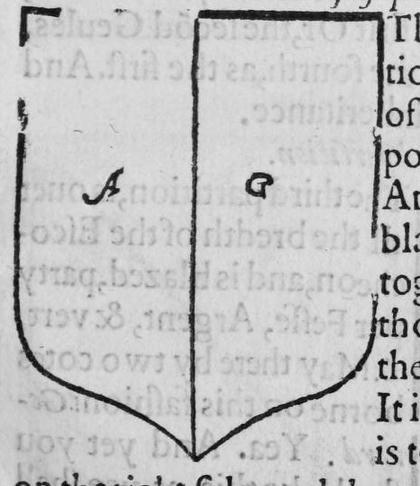 The first whereof is a partition from the highest part of escocheõ, to the lowest point, as heere appeareth. And although it must bee blazed so, yet is it a ioining together, and must bee thought of, as amongst the (withes) afore rehearsed. It is also, as a mariage, that is to say, 2 cotes, the man on the right side, and the woman on the left. As it might be said, that _Argent_ maried with _Gules_. But if it be no marriage, then ye shal say for the blazon thereof, party per Pale, argent, & gules, But somwhat to intreat Fol. 25v intreat of marriage. If the man haue maried an heire he shal beare her cote, none otherwise vntil he haue begotten an heire of the heire, Then may he, by the courtesie of armes, beare her armes in an Insccocheon, that is to say a Scocheon of pretence.
The second Partition.
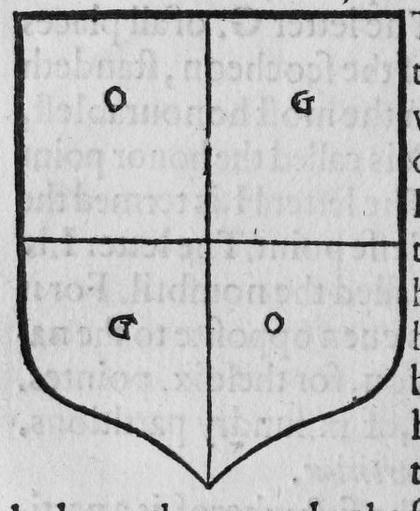 The second partition is on this wise, and is not otherwise blazed. Hee beareth quarterlie, _Or_ and _Gules_. Here is also to be noted, that if the man marrie an heire, and haue by her an heire, the same heire shall beare his fathers cote, and his mothers quartered, as this is, Then it shalbe said, he beareth quarterly, the first _Or_, the secõd _Geules_, the third, as the second: the fourth, as the first. And this betokeneth a fixed inheritance.
The third partition.
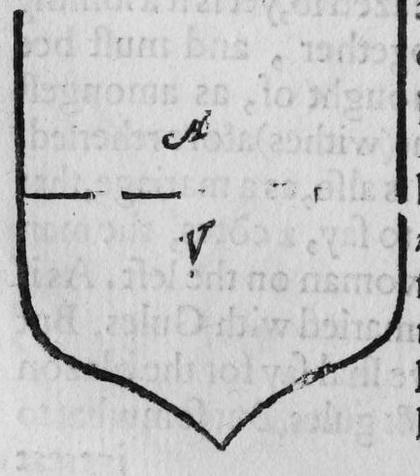 The third partition, is ouer all the bredth of the Escocheon, and is blazed, party per Fesse, _Argent_, & vert. **L.** May there by two cotes borne on this fashion? **Gerard.** Yea. And yet you shall take this, as yee shall take al the rest, for one only cote, But I wil shew you how they may be 2. cotes.
A man Fol. 26r marieth two wiues. The first wiues cote, shall stand on the chiefe part. The seconde wiues cote, shall stand on the base, and so they both shall stand on the left side of the scocheon, as parted per Pale. It is also at his choise, whether hee will set them in Pale with his owne cote: the first wiues cote next to himselfe, the seconde wiues cote vttermost. Le. What if he haue three wiues. Ge. Why, the moe the merrier. If there be seuen they shall all haue roome. But I saie, the two first mariages, shall stand ioinctlie on the chiefe point, and the last marriage shall take the whole base of the halfe Scocheon to her selfe. And if hee haue a fourth wife, then she must haue half that base part, So that cote shal seem as though it were quartered. All this is, if these wiues abouesaid were heires. If not, he can haue but the liuing cote, and no more to stand as a marriage, and none otherwise.
The fourth partition.
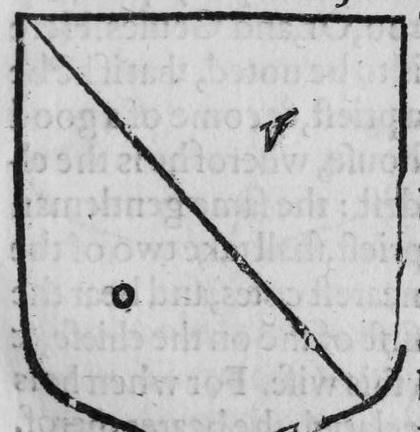 The fourth partitiõ is this: he beareth party per Fesse _Or_ and _Verte_. Here is nothing to bee considered, but as I haue spoken in the (withes) except this, that it is but one onelye cote. For cotes may not be ioined together on this fashion.
The fift partition.
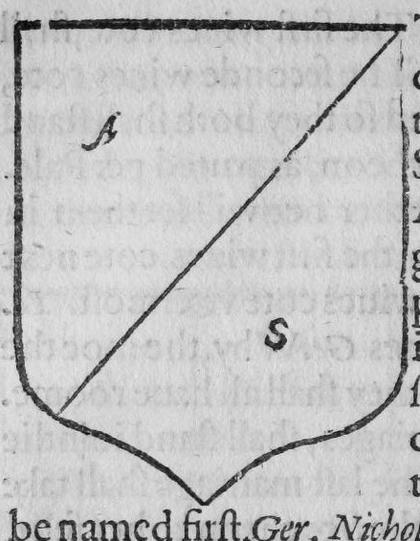 The fift partition is cleane contrary and is blazed on this wise, Party per bende Sinister, _Argent_, & _Sable_. **Le.** Wherefore do you begin to blaze at the dexter point, knowing that there is an olde rule, that which soeuer is of two colours doth occupie the point of the scocheon, that should be named first, **Ger.** _Nicholas Warde_, a good authour who wrote of this art, a hundredth xiij. yeeres past, saith, that whatsoeuer of mixt colours, doo shewe most in the field, that should be named first. He biddeth also, to giue preheminence to mettals.
The sixt partition.
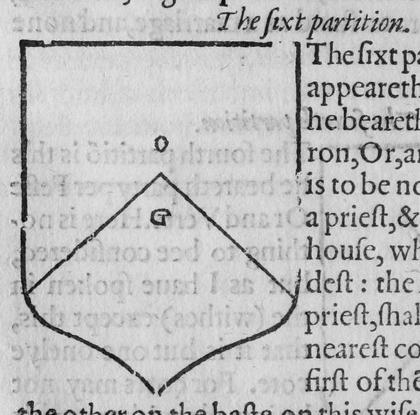 The sixt partition is, as here appeareth, & is so blazed, he beareth party per cheuron, _Or_, and _Geules_. Here is to be noted, that if he be a priest, & come of a good house, whereof he is the eldest: the same gentleman priest, shall take two of the nearest cotes, and bear the first of thẽ on the chiefe, & the other on the base, on this wise. For when he is dead, the cote liueth, & declareth the bearer thereof. But the same is neuer to be born of any other man in that order againe, I could shew you an example, but because it is as farre as Manchester, I omit it.
The seuenth partition.
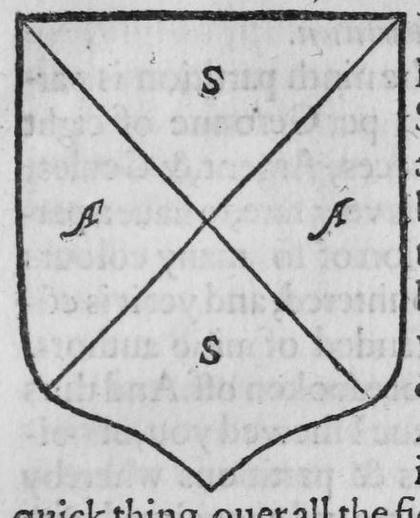 The vij. partition is this, Party per Saltier _Argẽt_, & _Sable_. This may be good armory, if al the 4. peeces bee charged with some thing, quick or dead. It is better if it be charged but with ij. things of one kind & that especially vpon the _Argent_, but best of all it is, to haue but one onely quick thing, ouer all the field I haue hard some, that hath termed this a Geron of 4. peeces. If _Vlpianus_ were liuing, he would be against that error, whose mind I vse in my Gerons, as hereafter ye shall see.
The eight partition.
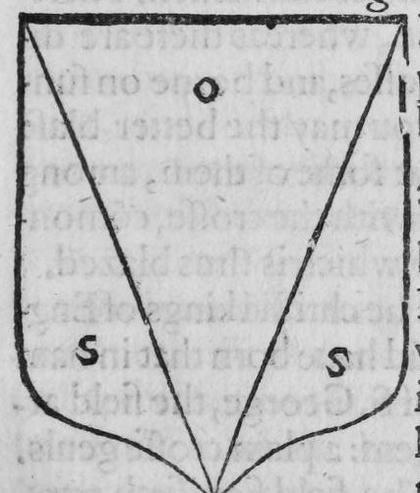 Here haue you the eight partition, which is to bee blazed on this fort: partie p pile in point, _Or_ & _Sable_. There may no part of this be charged, but onely the Pile part. And that may be vsed as one only cote. For if it be charged, you shall leaue the field vntolde. If this escocheon were made after the old fashion, you should see very little of the _Sable_. Therefore the pile hath the preheminence. And if it were square, as in banner, the ij. sides were ij. halfe Piles, & ioyned together one whole, as bigg as the Pile. **Le.** Wherefore do ye name _Or_, first? **Ge.** Because it both occupieth the chiefe of the Escocheon, and toucheth the three points thereof.
Fol. 27v The ninth partition.
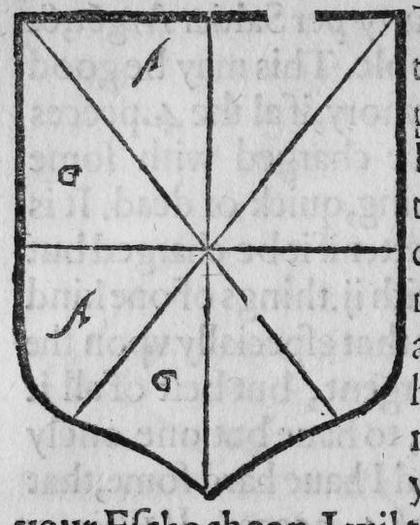 The ninth partition is parted per Geronne of eight peeces, _Argent_, & _Geules_. It is very rare, to haue a partition of so many colours countered, and yet it is cõmended of mine authors, afore spoken off. And thus haue I shewed you, of points & partitions whereby ye are wel acquainted with your Eschocheon, I wil therfore shew you of signes that are borne, and doe occupie the same Escocheon. And although the crosse of all other tokens be not most auncientest, yet most christianest. Therefore I will begin at the same, whereas there are diuers & sundry sortes of Crosses, and borne on sundrie waies, to the intent you may the better blase & tell of the like I wil set out some of them, among which number I will begin with the crosse, cõmonly called S. Georges crosse, which is thus blazed.
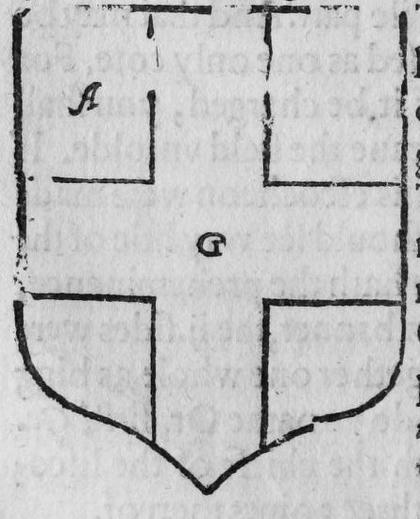 The christiã kings of England haue born that in nam of S. George, the field argent: a plain crosse geuls. The field signifieth purenesse of life, the crosse signyfieth the bloud that Christ shed for vs his people of England, whõ _Treuisa_ calleth the people of God, and the Realme he calleth Gods land.