The fashions of shields
So then euery noble man had a Token to shew of his Nobilitie and valiantnesse, And asFol. 16vter by a fairer name, they were called Armes because they were obteined by two or one of the 4. cardinal vertues at the least.
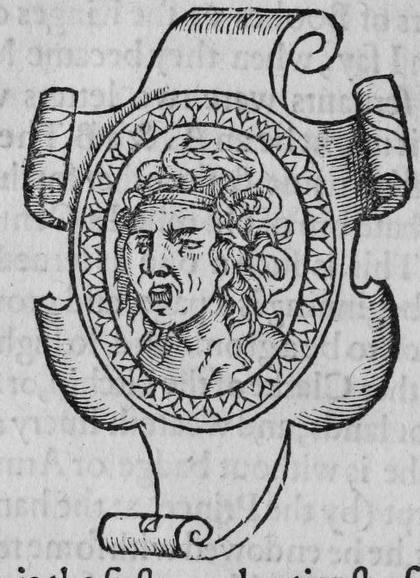 And this is the firste, and antientst of all others. Of this the Poets make mention in this wise. King Phoerus had issue three daughters, Medusa, Steno and Euriale. Medusa with Neptune the god of the Sea, committed adultrie in the Temple of Minerua, who was in reuenge thereof turned by the mightie Gods, into an ouglie monstrous shape, and her golden haires into foule lothsome serpentes, who enueying her life with further reuenge, seeking to haue that monster slaine, gaue a Christiline shielde to her liuetenant _Perseus_ the Palladian knight (son of the high Ioue begotten vpon Danae shadowed in the golden shower) wherewith when hee had slaine the horrible Gorgon _Medusa_, hee consecrated the same to mightie goddesse _Pallas_. Because by her Fol. 17r diuine power, he had the victorie. This shielde (the very patern whereof, standeth aboue) that noble souldiour _Vlisses_, withdrew out of the Citie of Troy, leauing not behind him the Image of _Pallas_, Before which thing done, the Augures said that it was not possible to winne that notable defended towne of Troy, Because ye shall thinke it no newe thing, it was 1774. yere of the world, & before the incarnation of Christ. 1189. yeares. This Goddes taught vnto the Libiãs all things appertaining vnto war. So that I take her for godesse of Herehaughts.
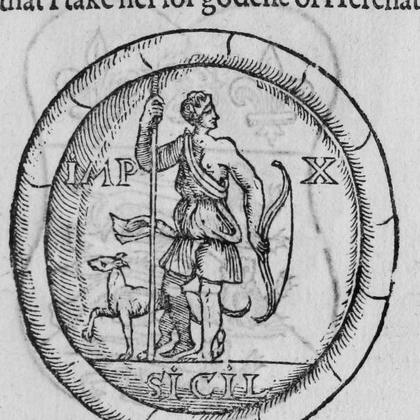 The seconde shielde was on this fashion, of the which forte, I reade of in the Bible that king _Salomon_ caused to bee made three hundredth of beaten golde. **Le.** Was this similitude vpon them? **Ger.** No, neither would I that you should haue respect to any thing that is set on any of these nine Escocheons. Because ye shall learne by them nothing of blazon, I set Fol. 17v them out onely for their sundry fashions; And for that I will not haue thẽ bare, I vse my fantasie. As for the similitude, that you see on this, I do it for antiquities sake. I haue seene it stamped in siluer xlj. yeres before Christes incarnation, by that noble man _Octauius_ the secõd Emperor of Rome, and nephew to that worthy conqueror _Iul. Cesar_, The fashion of the shield is aboue 2000. yeres past since the 1. deuise hereof, proued by good authority.
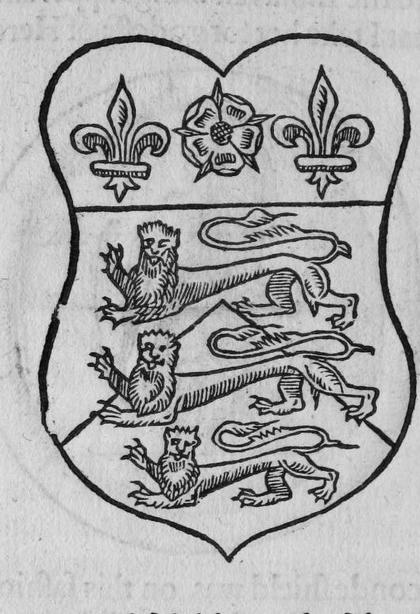 This is the third shielde, and of the Catelynes, whose leader was that woorthie Captaine _Catulus_, that subdued the Cimbrians, which was ten yeeres before the incarnation of Christ, This noble man reproued _Silla_ for killing of 1000. prisoners on this wife. With whom shall wee liue, if in warre Fol. 18r we kil the armed, and in peace the vnarmed? This man I say builded the citie of Tibor, in the remembrance of his brother Tiburtus.
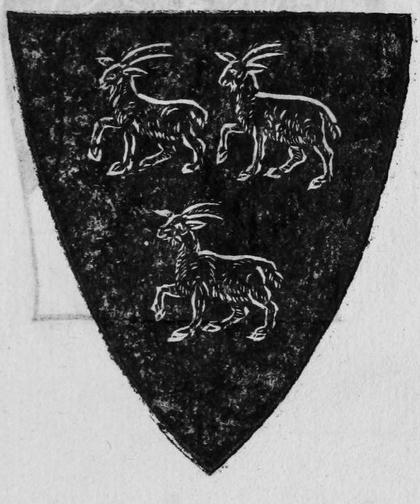 The people that nowe inhabite Mesopotamia otherwise called of the Frenchmen _Dierbechians_ they I say, haue of olde vsed this fashion of shielde which I thinke they had of the Troyans, and suppose it to be of greater antiquiite.
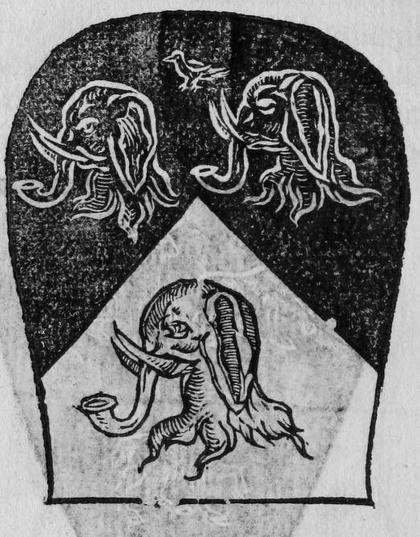 The fift shielde is on this fashion, it was vsed of the people inhabiting the Isle of Sardinia, called Sandalaries. This people would by art so harden these shields, made of the wood of Saunders, that vnneath they might be cut with sword, or persed with launce.
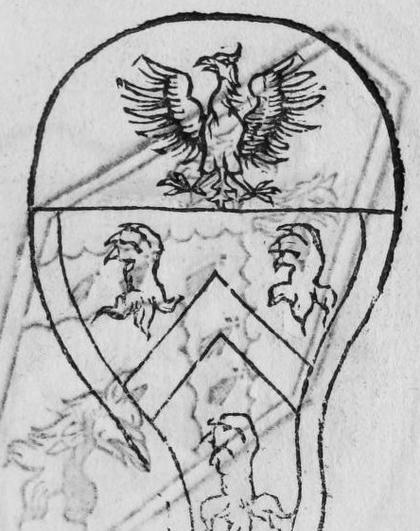 This shielde is the sixt of this number, and vsed of that valiant Captaine _Antonius_, a browne man of colour, and verie hardie, Hee tooke _Arabanus_, King of Armenia, tyed him in siluer bandes. He maryed with Royaltie, the famous _Cleopatra_, of _Ægypt_ Queene.
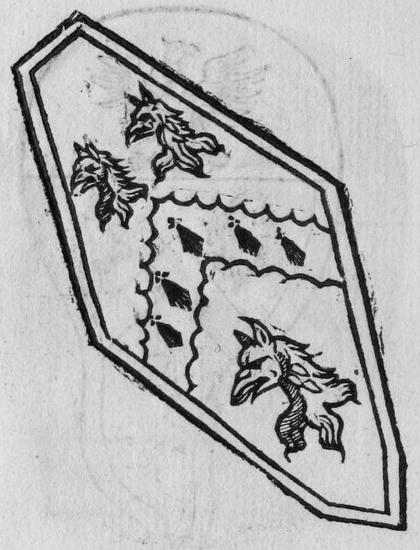 This is the seuenth shielde, and is, 3970 yeres old. For _Iasius_, which was king of Italie, with the helpe of the Sicilians had a sonne, whose name was _Coribant_, who succeeding his father, called his people Coribantes, This people (I say) vsed these shieldes with two dartes euery one of them on the backeside, which those people with the strength of their arme, would fling violently.
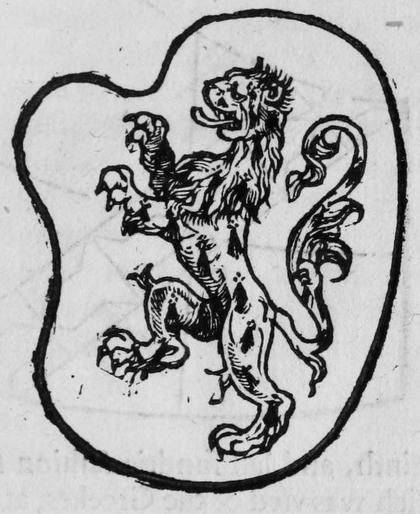 This is the eight shielde, and was vsed at the siege of Troy of the Troyan Horsemen that then were clad all in maile, who had one of these fixed before their brestes somwhat towards the left shoulder. And I cannot discerne but the shield that fell out of the aire in the time of _Numa_ king of the Romans was on this fashion.
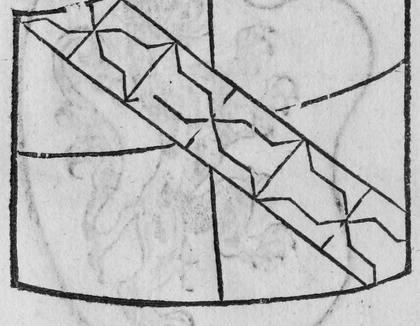 The ninth, and last sundrie fashion shielde, is this, which was vsed of the Greekes, at the recule of Troy, and yet vsed amongst them, and also amongst the Morisco Horsemen. And it is borne of them in such fort, as is to a woorthie defence of their bodies, for it gardeth the bodie from the waste vpwarde wholly. Nowe for because the fourth shield is transformed into an other fashion at these daies, as by all the scocheons of this booke ye haue at length, I say, though that the fourth shield was first made for horsemen, yet since that time it hath beene much vsed for footemen, and did containe in length v. foote, and in breadth at the chiefe two foote. I take to my witnesse sir Iohn _Froysart_, who writing of the battaile of Poyters smote Fol. 21r smote by the flowre of chiualrie surnamed the blacke Prince, who commanded that the bodie of the Lord Richard of Duras, shoulde be laide on a targe, that fiue men might beare the same to the Cardinall of Pirgorth for a present, with commendations from him. The which Targe, shoulde appeare to be either of that bignesse or bigger. **Le.** It is likely to be so if it were with others as it was with King _Alexander_: who, when he went against the puissant King _Porus_, being constrained to followe his enterprise, & to conuey his host ouer a riuer of wonderfull greatnes, wherewith his footmen being afraid, durst not aduenture to passe ouer the same, King _Alexander_ lamenting that he could not swimme, suddenly therwithal pulled a target from one of his souldiers, and cast it into the water, and stood vpon the same, holding him with his speare, and so conueied by wise guiding himselfe ouer the dangerous water. And I call also to remembrance, that in the latter ende of the raigne of valiant King _Edward the third_, the Frenchmen, to saue thẽ from the liberall shot of English Archers, had a shielde made of Elme, of vij. foote in length, & iij. foote in bredth, and an ynch of thicknes. This was, and is called a Pauice, & is now vsed on shipboord. These had the armes of the generall of the field vpon thẽ, and were brought thether in cartes, & made sharpe at the point to pitch into the ground. **Leigh.** Well, let that passe: and further, if I shoulde not make ye wearie of me, I could aske you one question more, and that is this, when began Armes? and whether at the siege of Troy, or not? Fol. 21v **Ger.** At the siege of Troy, there was a certaine perfectnesse of it determined amongst Princes, as in our dayes now we do perfit things that were but rudely done of auncient time. Some things also be vnperfite, that were done of our forefathers. I meane herein of no other thing, but of armes onely, and in Armorie, whose Lawes were before the siege of Troy, as appeareth in Deuteronomion: which hath had since that time so many additions, that fewe Herehaughtes know the Law of Armes, neither yet manie Ciuilians. But I say to you, it must bee verie auncient, for fielde and feight cannot be continued without Lawe, victorie alone being the Lawe-maker, who was 900. yeeres before the siege of Troy, and 1206. yeeres before the incarnation of Christ. The name of famous victorie first beganne among the Scithians, who were no lesse enobled by their women, then by their men: for they obteyned the Empire of Asia thrise, which they kept tributarie vnto them, vntill the time of Ninus, they them selues remayning continually without the subiection of other Princes. They put to shamefull flight _Darius_ king of Persia: they ouerthrewe _Zopirona_, the Captaine of _Alexander_, with his armie, they slewe _Cyrus_ with all his power: their women eke at the riuer Thermodoon, reuenged the death of their husbands with a slawter of a great number of their enemies, who after that by warre they had gotten peace, and by their hardinesse, wonne a great part of Asia and Europa, they made of themselues a kingdome, by the name of Amazones, whereFol. 22rof the most part were shooting women. They fought hand to hand with the most valiantest Princes of the world, as with Hercules, Theseus, Achilles, and the great Alexander himselfe. But what shoulde I neede to shewe you more of them? I would not haue said so much, but for the strangenes of the matter, for it were enough for my purpose, if it may appeare that they were warriours, and therefore say I, bearers of Armes, and that of auncient time. The orders of Armes were vsed in the Warres betweene _Ianus_ and _Cham_, on the one partie, and _Hamon_ and _Dionisius_ on the other side, which were 800. yeeres before the siege of Troy. Also _Iustinian_ writeth, that _Pallas_ did not onely teach the Libians the Law of armes, but also the feates of defence, belonging to warres. _Ascolanita Semiramis_ the widow of _Ninus_, excelled all other in chiualrie, magnificence, triumphes, and victories. She brought _Aethyope_ vnder her subiection, and made warre into India whether neuer any durst enter, but the great _Alexander_. And was any of this done thinke you, without ensignes and tokens of Armes? nay, and that might I shew you more plainly if I did not eschewe tediousnesse. As of _Aurelius_ the seventh Emperour of Affrica, who florished in wit of warrefare, and was 700. yere before the siege of Troy. But if I shoulde rehearse all the valiant Emperours, Kings, and Princes with their enterprises, it woulde be volumes, as of _Balleus_, that victorious Emperour of Assiria: _Phoroneus_, King of Argues: Duke _Moses_, that ouercame the Kings of Amorea, and Moabites, Fol. 22v vnto whom God spake, saying. Euerie man of the children of Israel, shall pitch vnder his owne Standard, and vnder the Armes of their Fathers house. And shall I forget _Iosua_, that mightie prince, who whilst the Sunne withdrew his course ouerthrew xxxj. Kings. This man being indued with all vertues, knew also the Lawe of Armes, without the which, neither battaile may be set, fielde pitched, or men marshalled to the wars. Doubtles euen from the beginning, in their cognisances, they vsed gards of sundrie colours about their garments, wreathes of two colours about their heads, as hereafter ye shall haue by example, _Osus_ a Prince of the Thuscanes, who raigned 105. yeeres before the siege of Troy, bare for his armes a Serpent. How think you by that worthie Duke _Gedeon_, that slew _Oreb_, _Zeb_, and _Zalmana_, with an hundredth and twentie thousand of Madianites and Arabies, was this done without Guidon, or Pinnonne? This was an hundredth yeres before the siege of Troy. If it were don without Law, then was it murther.
Duke Iosua.
Well, to make the matter more manifest vnto you, Duke Iosua the first of the nine Worthies (of whom I spake before.) This Iosua I say, bare perfect Armorie, which is thus blazed, Partie Bendie Sinister, Or, and Geules, a Backe displayed, Sable. Le. Did all the other eight beare Armes also? Ger. They did, whereof I wil notifie vnto you in blazon orderly as they were nere this time.
Fol. 23r Hector.
The seconde Worthie, was Hector of Troy. He bare Sable, ij. Lyons combatand, Or:
Dauid.
The thirde was Dauid, and hee bare Azure, a Harpe Or.
Alexander.
The fourth was Alexander, the which did beare Geules, a Lion Or, seiante in a Chayer, holding a battell axe Argent.
Iudas Machabeus.
The fift was Iudas Machabeus, whose shielde was Or, ij. Rauens in pale proper.
Iulius Cesar.
The sixt was Iulius Cesar, who bare Or, an Eagle displayed with ij. heads Sable.
King Arthure.
The vij. King Arthure, and he had his shielde Azure, xiij. crownes Or, 3.3.3.3. and 1.
Charlemaigne.
The viij. was Charlemaigne and he bare the Ierusalem shielde, Impaled with the imperiall Cote, as hereafter ye shall see more at large.
Sir Guy.
The ninth Sir Guy, Earle of Warwick, who beareth Checky, Or, and Azure, a Cheueron Ermine. All which, I haue shewed you for the antiquitie of armorie. And although the siege of Troy bee of auncientie 2751. yeeres past: yet if yee weigh the matter, ye shall perceiue that bearing of Armes, & Armorie, are much more auncient, But the vniuersall goodly order was not then such as is now, Fol. 23v For vntill that time, Mettall was not knowne from colour, neither was there any Rules made before: for without difference one man bare an others Cote, whereupon grewe strife, the ende whereof was losse of life. And furthermore for the antiquitie of Armorie, I will shewe you the thing I found in an author entituled, Gesta Troianorum, wherein ye shall find the selfe same wordes as they here followe. In auntient time I reede, that there was no other order but two, that is to say, Wedlocke and Knighthoode. A Knight was made before any cote Armour, whereof Olibion was the first that euer was. Asteriall his Father came of the line of that woorthie gentleman Iapheth, and sawe the people multiplie hauing no gouernor, and that the cursed people of Sem warred against them: Olibion being a mightie man and strong, the people cryed on him to be their gouernour. A thousand men were then mustered of Iaphetes line. Asteriall made to his Sonne a garland of nine diuerse precious stones in token of Cheualrie, to bee the gouernour of a thousand men. Olibion kneeled to Asteriall his Father, and asked his blessing: Asteriall tooke Iaphetes Fauchen that Tubal made before the fludde, and smote flatling nine times vpon the right shoulder of Olibion, in token of the nine vertues of the foresaid precious stones, with a charge to keepe the nine Vertues of cheualrie, as followeth, saying:
1 You shall holde with the sacrifice of the great God of heauen.
2 You shall honour your Father and Mother.