The metals
The Accedence of Armorie
Fol. 1r Leigh. Gerard.
[Woodcut initial C.] O D saue you Sir Herehaught. Gerard. And you also. What are you and wherefore come ye hither? Leigh. I am a Calighate knight, & vnderstanding ye are an Herehaught, come to learne those things, that you are bound to teach me: that is to blaze Armes, with all the termes thereto apperteining, with my seruice to my Soueraigne. Ger. And if I were not bound to doo it by mine Othe, yet of courtesie I will teach you. And because ye are willing, I will the sooner instruct you, euen from the beginning to the end, Telling you for the first point, that there are nyne sundrie fieldes, of the which, seuen of them be termed colours, and two, Mettals. Le. which are they? Ge. The two mettals are Gold and Siluer. And the seuen colours, are Red, light Blew, Blacke, Greene, Violet, Orenge-Tawney, and Murrey. But you must not so terme them. Wherefore, I will set their proper names within euerie of their Scotcheons. And for to call them by these names, it were shame amongst the Herehaughtes, and not worthie the name of blazon. But to the effect. First I will begin with the most precious mettall, Golde.
(Or.)
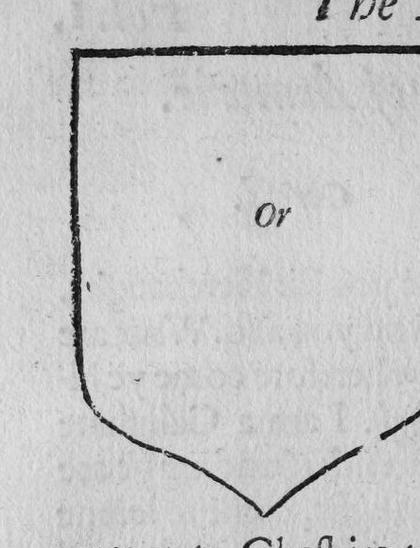
L. That word is French, And wherefore do ye blase in that language? G. I blase not in that language: But the termes of blasonne are in that language, and I will tell you why. Sithens the time of that famous prince King William the Conquerour, who ouercame this realme with his Normans, euen vnto Cheshire to the Malpas, that language hath bin commen to euerie Englishman. Likewise, by the victories of that puissant Prince King Edwarde the thirde, conquering twise so much in France, as the Conquerour did in Englande: It came to passe, that wee haue bin mixed, as well in language as also in bloud. For beyond Burdeaux, the English speech hath beene as commonly talked, as in London is now both French and Dutch. Since that time (I say) they haue beene vsed as wel here in, as in the Lawes of this Realme, the names of all offices, and officers, and in a manner, in all gentlemanlie games and pastimes, as hawkinge, hunting, or otherwise. And now to speake of the worthines of this mettall, Golde, Aristotle sayeth, it is fyred and when it is fine, it will not rust: so will it not melt in the fire without Art, Plato telleth of it to be plyant, pure, and temperate, and to haue vertue to cleanse superfluities gathered in boddies, whereupon hee declareth, that it helpeth Leprosye, and clenseth meselrie. Auycenne reporteth, that the Fol. 2r fylings of Gold, put into meate or drinke, taketh away the trembling of the heart, swowning and the splenatique disease. Leigh. Why set you foorth such commendation of gold? is such praise also required in your Arte? Ger. I say thus much, and must yet saye more in commending of the worthinesse thereof. For looke howe much this mettall excelleth all others in the kinde thereof, as in finenesse and puritie: so much should the bearer thereof, excell all other in prowes and vertue. Therefore, sayeth Christine of Pice, no man should beare this mettall in Armes, but Emperours and Kings, or of the bloud royal. Le. Are there not many that notwithstanding, beare golde in their armes, and are not of the bloud royall? Gerard. Yes. But Christine spake it, as onely for the woorthinesse thereof. Meaning that as none ought to be worthier then they: so they shoulde beare the worthiest mettall of all other. And yet I might say more in commendation thereof. Le. By your leaue, I perceiue then, that it was not in vaine that Phalerius sayde, they would digge Pluto out of hell for Golde. The which whether it were for the worthines of the mettal, or for couetousnes of their minds: doubtlesse not onely they, but many moe, haue in such fort desired it, that some haue ventured body and soule to beare it. Ger. Whensoeuer I speake of bearing, I meane the woorthinesse of the bearer, for honours sake. And so worthie is this mettall Golde, as it hath not beene, but well remembred to be spoken of in the Bible, as in Exodus by the commandement of God, when there were diuerse Fol. 2v instruments appointed to bee made to his honour, then Golde was vsed as mettall fittest to serue for the same purpose. Le. I pray you nowe abridge off your talke thereof, for I know it to bee precious, and I my selfe will conclude the whole matter, with that wittie saying of Philip that mightie King of Macedonia, who being fully bent to take a certaine Castle, whereof it was told him by his Souldiers, that it was a thing vnlikely by strength of man to be ouercome, asked of them if it were not possible for an Asse heauie laden with gold to haue accesse thereto. Gerard. In deede, this perswadeth further to make me thinke that Golde is not onely vertuous, but also victorious. Well nowe to leaue this matter, and come to an other, I will shewe you of that planet, whereunto Gold is resembled. The Sonne is likened thereto, and is vsed likewise in blazon. The Philosophers write, that as the harte in man is the noblest: so is this Planet, of all other the worthiest, and as it were the verie comfort of them all. Euen so Ambrosius in Exameran saieth, that the Sonne is the eye of the world, mirth of the day, fairenesse of heauen, measure of times, vertue and strength of all that is engendred. Martianus telleth, that the Sunne passing in the middle of the circle of the Zodiack, sendeth from himselfe twelue beames, by which the vpper and nether bodies are comforted. The Sunne (sayeth hee) is the well of the minde, reason, might, and in witte of the worlde, and moderator of the firmament, Macrobius sheweth in defynng the Planettes, that the light of all the roundnesse of Circles, commeth of Fol. 3r the Sunne. And that hee is in the middest among the Planettes, to make Harmonie and accorde, as the middle string of an Instrument of Musicke. Ecclesiastes sayeth, what is more cleare then the Sunne? The Sun sayth he, ouerlooketh all things and declareth the day. Leigh. Can ye say any more in commendation of this Planet? Gerard. Yea, twise as much, if it were not for making you wearie. But to conclude, Saint Mathewe writeth, that Iesus when he was transfigured, his face shone as the Sunne. And hee saith also, in the ende (whereby hee meaneth the ende of endes) the righteous shall shine as the Sunne. Well, nowe I will proceede to that precious stone, which the Herehaughtes doo vse in blazon, for, and in the name of this mettall, and Planet that is called a Topace, which stone, for his vertue, is sayd to bee noble. And as Dioscorides writeth, it swageth wrath, sorrowe and euill thoughtes, and healpeth the bearer thereof of frencie and soddaine death. This Stone, for his woorthinesse, was set in the brest lappe of Aaron. Leigh. Are these so manie and sundrie blazons, vsed of all Herehaughts? and are they all auncient? Gerard. These three sortes haue beene vsed, and are as auncient as from the first beginning of Armes bearing. And there are three other also, but they be of nearer time. As blazon by the dayes in the weeke, deuised by Fawcon, principall Herehaught of Englande, in the time of the famous King Edwarde the thirde. Also blazonne by Flowers, deuised by a French Herehaughte called Mallorques, in the tyme of Fol. 3v Charles the seuenth French king, And last the blazon by the principall parts of mans bodie deuised by an Almayne in the time of King Henrie the fift. But all those I omit for lengthning of time. Now will I shewe you the meaning of this mettal and that it is sometime simple, and sometime compounded. Le. How is it when ye call it simple? Ge. The Scochon is then, either mettall or colour, onely a field. Le. But is that good Armorie? Ge. Yea and verie auncient. And who that beareth so, it being Or, signifieth vnto them, wisedome, riches, magnanimitie, ioyfulnes and elation of mind. Le. I pray you tell the compounds. Ge. I will. You must note by the way, that compounds are sometime termed partitions, and yet are they still called compounds, whereof I will shew you hereafter at large, when you shal terme them compounds, and when perticions. Nowe I will onely shewe the composition, or ioyning of mettall or colour, with Gold as followeth.
1 But simple, first it signifieth as before is rehearsed.
2 With Argent, to be a victor ouer all Infidelles, Turkes, and Sarazins.
3 With Gules, to shedde his owne bloud for the riches of this worlde, and liberally to spende it.
4 With Azure, to be trusted to keepe the riches of the world for himselfe, and from others.
5 With Sable, constant in euerie thing, also in loue.
6 With Verte, ioyfull with worldly riches.
7 With Fol. 4r Purpure, a frend to his enemy.
8 With Tenne, patient in trouble.
9 With Sanguine, trusteth and soone deceiued.
Le. I perceiue you well. Go nowe to the seconde mettall.
Argent.
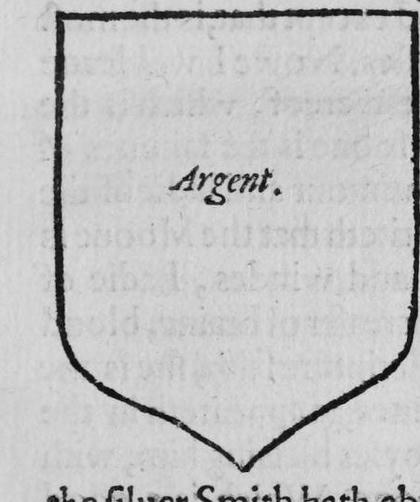 **Ge.** That is called Siluer, and blased by the name of Argent. It is a royall mettall, and doth honorable seruice to princes, as well in vessell of housholde, as for the larges in gift thereof. It is commonly known to be of such nature, that it will not bee wrought with the hammer before the siluer Smith hath abased it with copper. Being fine, it is said to be medicinable. **Le.** You digresse now, and meddle with that that apperteinethe not to this Art. **Ge.** I maruell what Science, Arte, or mysterie it were, that an Herauld shoulde haue none intelligence thereof were it neuer so secrete or profound? For, if he haue not of all things some vnderstanding, as well as of seuerall languages, he is not worthie to be an Herehaught. Therfore necessarie it is for him to haue an vniuersal knowledge in eche thing. But though this in deede concerne an other Art, yet our part is to set out that we doo to glorie. For looke what soundes to praise and commendation, that we meddle and must haue to doo withall. But because ye haue taken me vp so farre at the Fol. 4v beginning, as though ye thought I would haue bin long in praising of Siluer, as I was of Golde, I will for your ease cutte of much that I was minded to haue spoken of. To conclude therefore, onlie note this. That as the pretious mettall golde dooth in his nature excell all other: So is Siluer onelie excelled thereof, and except that, is the most pretious of all other mettalles. Nowe I will leaue it, and come to the planette thereof, which is the Moone. _Plinie_ saieth, the Moone is the fayrenes of the night, mother of the humour and ladie of the sea and times. _Macrobius_ writeth that the Moone is the chaunger of the ayre and windes, Ladie of floudes and ebbes, and encreaser of braine, bloud and marrow. The holie Scripture saith, she is the ripener and increaser of fruites, as appeareth in the benediction of _Ioseph_, _Moyses_ blessing him, with the ripe fruites of the Moone. Which is a good proose, that the Moone bringeth ripenesse vnto fruites, though it seeme a thing contrarie to reason. And so there I leaue, and come nowe to the pretious stone, called the Pearle, which _Isidore_ writeth to be engendered of the dewe of the Heauen. _Plato_ saieth, the Pearle hath vertue comfortatiue, and restoratiue, and is foode to man: which is verified by _Iosephus_, who sheweth that when Ierusalem was besieged by _Tytus Vespasian_, the Iewes liued long, hauing nothing to eate but only pearles. _Aristotle_ telleth, that Pearle hath a singular vertue in comforting the braine. The kingdome of heauen saieth Christ, is like vnto a Marchant seeking goodlie Pearls, which when he found one precious pearle, sold Fol. 5r all that he had and bought it. Whereby Herehaughts may learn to bestow this pretious treasure vpon such as woorthilie will esteeme the same, and to rewarde the Oxe with haye as _Agrippa_ well noteth. And so ende I with this mettall, planet and stone, shewing vnto you the signification of the mettall.
1 Simple of it selfe, it signifieth to the bearer thereof Chastitie, virginitie, cleare conscience, and Charitie.
Compounded
2 With Or, to reuenge Christ bloudshed.
3 With Gules, bold in all honestie.
4 With Azure curtesie with discretion.
5 With Sable, yeelding vp all pleasure.
6 With Verte, in youth vertuous, and continuance thereof.
7 With Purpure, the louing fauor of the people.
8 With Tenne, to be content with sufficient.
9 With Sanguine, to recouer an ouerthrow.
Le. I pray you satisfie me in one thing that I will aske you, whereby I may the rather vnderstande your compounds. For in your compounds of golde, with all other, you haue sett the siluer, and shewing your meaning thereof, in that place your saying is, with siluer, and here ye say with gold, and to mine vnderstanding, they ought both haue one meaning. Ge. It might seeme so to the vnskilful, but you must vnderstad that in the treaty of gold, when I say with Argent, which is as much to say, as with siluer, the gold is there first. So herein this place, when Fol. 5v when I saie with Or (which is to be vnderstanded with Gold) the siluer is first. For that must bee a generall rule vnto you for the first naming of euerie thing. For therein standeth a preheminence. Le. I doo now vnderstand you. As though the field of the Scocheon were of both these mettals, of the which (by the means of the standing of them) there should be a regard, and that is shewed by the meaning of this word (with.) Well now I pray you to proceed, and shew me of the vij. colours.
Geules.
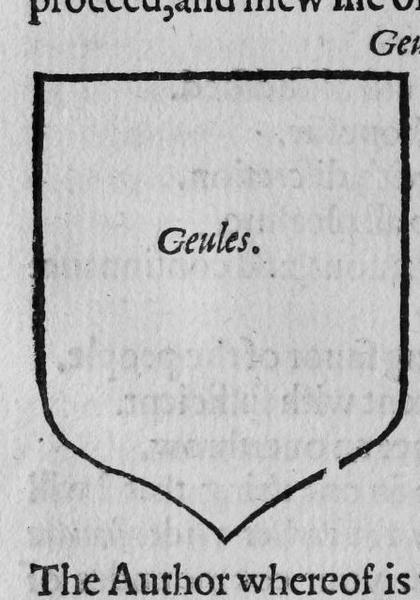 **Ge.** The first of these seuen colours, is called _Geules_. And in colour neither red nor Sanguine, but is the verie vermilion it selfe, for that is right Geule. It is a royall colour, and hath that proper qualitie in it selfe, that it may not be gased on any while. For then the eie is wekened thereby. The Author whereof is proose it selfe. **Le.** I thinke you may bee to seeke for commendation of this colour, for I haue not hearde much either spoken or written in praise of it. Can ye say any thing? **Ger.** Although it shew it selfe to be commendable, yet shall it not want my praise. I were neere driuen to the wall if I had no more to commend this colour by, but that wherewith the French Herehaughtes did sette foorth their _Auriflambe_ which came from Heauen, as by vayne miracle they faine. But Fol. 6r they that make such shift, shoulde rather haue taken occasion to praise the same, for that the Red Rammes skinnes couered the arke. And that is no fable, Yet for my promise of commendations, I say to you it is, & long hath bin vsed of Emperours and kings for an apparrell of maiestie, and of Iudges in their iudgement seats. Also God the father, promising redemption to the people by the passion of Christ saieth, what is he that commeth from Edom with red coloured clothes of Bosra: which is so costlie cloth? Besides this, it is often spoken of in the scripture, which I leaue of for lengthning of time. Now will I speake of the planet Mars, which is the planet, that this colour apperteineh to, and is of all other the hottest, and most firie. _Martianus_ telleth, he is the Armipotent God of battel, whose hardie desire is to be auenged with speedie boldnesse. _Ptolemeus_ saith, this planet maketh a man apt to all firie workes. **Le.** If this be al the praise you can giue him, you will no more offend me with tediousnes. **Ger.** What needeth more then enough, can ye not vnderstand hereby what the nature of Mars is? **Le.** Yes verie well. **Ge.** Why then I will shew you of the precious stone apperteining to that colour and planet, which is called a Rubie. It is a stone of dignitie, and as _Isidore_ writeth, is of the kind of Carbuncles. This pretious stone, neither fier wasteth nor changeth his colour. This was one of the precious stones that was set in the brest lappe of Aaron. Of diuerse authors, this is diuerslie and wonderfully commended, for his singular vertues. As who list to reade, may finde plentifully enough Fol. 6v written thereof. Nowe to the colour simple, and compound.
Of it selfe.
1 It betokeneth strength, boldnesse with hardinesse.
2 With Or, a desire to conquer.
3 With Argent, enuie reuenged.
4 With Azure, to win heauen by good deeds.
5 With Sable, hateth the worlde with wearinesse thereof.
6 With Verte, bold of courage in youth.
7 With Purpure, strong in deed, iust in word.
8 With Tenne, mortall hatred.
9 With Sanguine, enemie to Venus pastime.
Le. Now if it please you, to the second colour. Ge. That is called light-blewe and named of Herehaughts.
Azure.
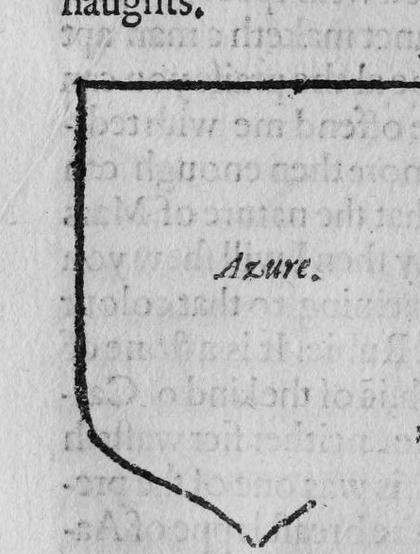 Azure: It is royal & a colour of heauenly hew. For when the Sunne shineth most clere, & that all cloudes are put to exile, the firmament is all wholly of this colour, which is onely of the purenesse of the aire. Whereof Iob speaketh to the busie searchers of gods mysteries, saying, Then shal the residue of the life be as cleare as the noone day: which to the iudgement of man is all Azure. Whose proper planet is Iupiter, which by his goodFol. 7rnesse as _Martianus_ saieth, abateth the malice of Saturne, Therefore the Poets faine, that hee did put his father out of his kingdome: _Isidore_ writeth, as he abateth the malice of the euil planets, so he augmenteth the goodnes of good planets, whose precious stone is the Saphier, which as _Isidore_ telleth is both noble and excellent, and to be worne vpon the fingers of Princes. _Dioscorides_ writeth of it, saying: It lightneth the bodie and preferueth the limmes whole. The Saphier (saieth hee) is the Carbuncles mother. For the Carbuncle is found within the Saphyer, as the childe within the wombe. He saith also, it hath a singular vertue, to accord people in strife, and to abate vnkind heate of burning feuers. Bound to the poulse, it helpeth against melancholie, and stauncheth bleeding that commeth of anguish, and is a remedie against venome, and preferueth the sight. In the old time, it was onely hallowed to _Apollo_, the rather to haue a speedie answere of him, of those things that were requested. Here ending with this colour, planet, and stone, I will enter into the significations.
1 Which simplie, sheweth the bearer to be of godlye disposition, and in renowne to the end of the worlde.
2 With Or, the ioyful pleasure of riches.
3 With Argent, vigilant in seruice.
4 With Geules, readye to reproue villaynous deedes.
5 With Sable, lamenteth all mens hurts.
6 With Verte, to preuayle in all newe enterpryses.
7 With Fol. 7v Purpure, good in Counsell, and to be beleeued.
8 With Tenne, soone angry, and soone pleased.
9 With Sanguine, long or he be mooued, either to good, or euill.
Le. The third colour and fist field, is blacke, what say you of it? Ge. I say it is so of colour, but must not so be called, but Sable.
Sable.
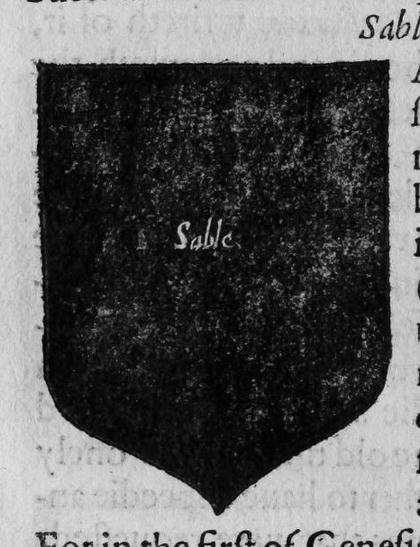 And although it do represent moorning, yet it is honourable, and worthie to be borne in armes, so that it be borne orderlie. Black (saith _Aristotle_) is the priuation of white, or clearenesse that is engendred of darkenesse. Whereby it should appeare, to be the ancientest among colours. For in the first of Genesis it appeareth that darkenesse was before God made light, and then darkenesse would haue beene fellow with light, if God had not seperated them. I coulde shewe much commendation thereof, by authoritie of scripture. But for tarrying too long on one thing, I ouerpasse that colour, and will beginne with this planet, whose name is Saturne, that highe and mighty potentate, which surmounteth so much all the rest in degree. Vnder whom are brought out graue and deepe counsellers, great builders, and repairers of antient houses, plentiful keepers of them, and long liued men. Whose precious stone is the Diamond, Fol. 8r which of his hardenesse perseth all other stones and mettalles: whereof it is said by Ezechiel, Thy forehead shall be harder then the Diamond stone. As who should say: thy forehead shalbe as hard as that which hath nothing to compare with it in hardenesse. This stone is called of the Greekes, by the name of a vertue, as may not be daunted. _Isidore_ saieth, it warneth the bearers thereof to eschewe venome. _Dioscorides_ writeth, that it withstandeth witchcraftes. This stone (saieth he) borne on the left shoulder hath vertue against chidings, & strife of enemies. **Leigh.** What are the significations of this colour Sable? **Gerard.**
1 Of it selfe constancie, diuine doctrine, and heauinesse for losse of friends.
2 With Or, honor with long life.
3 With Argent, famous.
4 With Gules, to be feared of his enemies.
5 With Azure, studious to appease strife.
6 With Verte, after great sorow, much ioy.
7 With Purpure, religious to the death.
8 With Tenne, vnquietnes hindereth his desire.
9 With Sanguine, prosperous in Pionary.
Le. I haue hard it said of Herehaughtes, that siluer and Sable is the richest shielde of all other. I pray you tell me whether it be so? Ge. No, whosoeuer saith so mistaketh the matter. For we haue in armes bearing three sundry degrees. And they are all Superlatiues, as followeth.
1 Most rich.
2 Most faire.
3 Most glittering.
Le. Fol. 8v I pray ye tell me which they are, and how I should knowe them. Ge. When the field is Or, and the thing that occupieth the field, is Sable, that cote is most riche. Le. What is your reason? Ger. When the Diamonde is set in Golde, the mettall honoreth the stone, and the stone the mettall. And if it were set in Siluer, the stone shoulde honour the mettall, and the mettall abase the stone of honour. And so that colour is most richest, when it is in most richest fielde. Leigh. And what say ye by the seconde? Gerard. Most fayrest is that, that may bee farthest seene, or best perceiued. The which is, when the fielde is Argent, and that that occupieth the field, is Sable. Leigh. What is the reason? Gerard. Argent will bee seene in the darkest place that is, and contrarywise, Sable will bee seene in the most clearest light that may bee. So these are euen as light and darkenesse. And sithen of nature they may be seene farthest of all other colours, therefore is that shield called fayrest in the fielde. And as for the thirde, you knowe the value of Golde, you knowe also the riches of the earth, when it is cladde with that comfortable colour, Greene: both which are ioyfull to beholde, aswell to man as beast, being not onely to them great delight and comfort, as also the onely mean of all their chiefest sustenance. When these two richesses (I say) are borne together, it geeueth reioysing to the hart of the beholder. And therefore when Gold is the fielde, and Verte occupieth the same, then is it most glittering. It is written in Ecclesiastes.