Front matter
Title page
A1r The Accedence of Armorie.
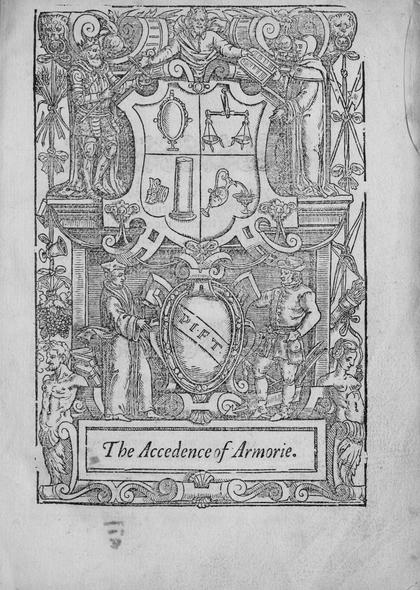
The verses
Aduise you well this worke ere ye reproue,
Conceiue it warely, read it more then once,
Be learned ere ye teach, leaue off selfe loue,
So shall you find an Art, worth pretious stones.
Although by kind the (Backe) will not abide,
The glittering shew of comly Phebus course,
But from the light aie shrowds her selfe aside,
Apolloes beames pardy shine nere the worse.
To the honorable assemble of gentlemen
A2r To the honorable assemble of gentlemen in the Innes of Court and Chauncerie, Gerard Leigh wisheth loyaltic.
Considering (right Honorable) dutie that I owe to my naturall Countrey, and that I haue a talent to vse to the increase of vertue, by which I am stirred to set foorth some part of my time spent, in discharge of my dutie towards God, and the world: Wherefore taking boldnesse, partly of your benigne inclinations, towards the auncient tokens of Armorie, as right wel appeareth in the most ancientest of your houses, now newlie re-edified: I haue therefore enterprised to set out in the English toong, the Blazon of Armes, which are aswel gathered out of the holie Scriptures, as of other most ancientest Authors.
And although those be worthie of great laude, that found out the sciences liberal, wherewith the soule of man is beautified. Yet is there due as great commendation to them, that hath searched foorth the way, to make the bodie not much inferiour to the soule, And those are they that haue written, and be the authors of this science or sciences. They I say, are named ancient Herehaughtes, who haue made distinction betweene the gentle and the ungentle, in whom there is as much difference, as betweene vertue and vice. For the which we are bounde to make for them a worthie memoriall, declaring our kindnesse dewe towards them. Of which sort, I will shew so manie, as I haue authorized this phamphilet by. And they are of number ix. as followeth. 1. Nicholas Vpton, deserued blasonne. 2. Nicholas Warde wrote of the whole worke. 3. Bartholus of tricking, and differences of brethren and kinsfolke. 4. Vlpianus wrote of the whole. 5. Buddeus, of the beginning of the Law of armes. 6. Alciatus the booke called Parergon. 7. Fraunces of Foea, of vnperfect coulours. 8. Honorius, of the order of battailes and combat. 9. Iohn le Feroune, of the blazon of colours.
The Preface
A2v And though I haue of these nine authoritie, yet my attempt is not of presumption to teach, (I my selfe hauing most need to be taught) but onlie to the intent that gentlemen, that seeke to know all good things, and would haue an entry into this, may not finde here a thing expedient, but rather a poore helpe thereto. And for because in matters of learning, great volumes are of little price, vnlesse the matters therein be of themselues worthie: therefore I thought good, rather to write some little booke of rare title, then to make a great volume of common matter, And for somuch as this treateth of blazon of Armes, and of the worthie bearers of them (which Plato affirmeth to be the vpholders of the common wealth, & Salomon saith likewise, where such be not, the people shall fall to ruine) I therefore, haue named this, the Accedence of Armorie, and doo now dedicate it vnto your honors, as the first fruits of me gathered in other mens Orchards, Trusting that your wisedomes will take in good part my meaning & indeuour (although opprest with rudnesse) by the example of king Artaxerxes: who disdained not the poore husbandman his homelie hands-ful of cleane water, but thankfully receiued the same, esteeming the present not after the value, but after the will of the giuer, by which it appeareth, that the mind of man enricheth the value of euery thing, & not the greatnes thereof. And if (most graue lawyers) I may perceiue your good contentation with sent
A3r this, I shall God willing, after my returne from Venice, present you with the Genealogie of all the kings of England, since the conquest hetherto: the rather because I haue seene a booke of the Genealogie of the kings of France & French kings, wherein might faults be espied, if it were as diligently looked to, as it hath bin long looked for. And yet I think him an Herehaught that compiled the same. But where I shall in this booke commend any one cote, or dispraise, I protest vnto you, my meaning is but the general description of the one and of the other. And againe, how many soeuer I set forth, I meane to name verie few, and such they are, as be gone from the world, of whom I am sure to be vnthanked. Wherefore most humbly I beseech your honours, to daine to be patrons of this my worke, against the middle finger pointings of the vngentiles, disseuered into iij. vnequal parts. The first whereof are gentle vngentile. Such be they as will rather sweare armes then beare armes. Who of negligence stop mustard pots with their fathers pedegrees, or otherwise abuse them. The second sort, are vngentle gentlemen, who being enhounced to honor by their fathers, on whom (though it were to their owne worship) yet can they not keepe so much money from the dice, as to make worshipful obsequies for their said Fathers, with any point of armory: but despise the same, because (say they) those his armes were purchased for slips. Most of these desire the title of worship, but none do worke the deed that appertaineth thereunto. And of these that runne so farre as will not turne, old women will say, such youth will haue their swing, and it be but in an halter: but God keepe them from that. The third sort, and worst of all, are neither gentle vngentle, or vngentle gentle, but verie stubble curs, & be neither doers, sufferers, or wel speakers of honors tokens. As of late, one of them was called to wor-
A3v ship in a Citie within the province of Middlesex, vnto whom the Herehaught came, and him saluted with ioy of his new office, requesting of him to see his cote, who called vnto him his mayd, commanding her to fetch his cote: which being brought, was of cloth garded with a burgunian gard of bare velvet, well bawdefied on the halfe placard, and squalioted in the fore-quarters. Lo, quoth the man to the Herehaught, here it is, if ye will buy it, ye shal haue time of payment, as first to pay halfe in hand, and the rest by and by. And with much boste he said, he ware not the same since he came last from Sir Iohn Shorne. The Herehaught being somewhat mooued, said: I neither asked you for this cote-shepe cote, or hogges cote, but my meaning was to haue seene your cote of Armes. Armes quoth he, I would haue good legs, for my armes are indifferent. This man was a horsman, but not of the lightest sort, or such as are called light horsemen. For (saith the Herehaught) such haue feete and cannot go, legs they haue, but they cannot stand, let them be like such as dispise all gentlemen, and euermore be infected with the gout. I could shew you of the end of him, but because this little booke ought to follow the matter, whereof it beareth the title, which shal be done in familiar talke betweene Gerard the Herehaught, and Leigh the Caligat knight, therefore I leaue off. And thus praying you to suffer Diogenes to lye groueling stil, which if ye do not, he wil reproue you, as he did one that was suspected of robbing dead mens tombes, whereof ye are neither doers or sufferers. And so praying to God to keepe you stil in that mood, to whom I commit you with the end of my preface. Humbly beseeching you to vnderstand ere you iudge.
Richard Argall of the Inner Temple
A4r Richard Argoll of the Inner Temple wisheth the Reader aduancement by Vertue.
The common saying is that the Iuie bush is hanged at the Tauerne doore to declare the wine within: But the nice searchers of curious questions affirme this the secrete cause, for that that tree by his natiue propertie fashioned into a drinking vessell plainly describeth vnto the eie the subtill art of the Vintner in mingling licors, which els would lightly deceiue the thirstie drinkers tast. And therefore where good wine is according to the prouerbe needeth no bush: euen so to praise it whose excellencie vttereth it self, is but matter superfluous and meere mispent time. For loe, the verie title of this worthy worke stryeth the glauncing eye of the passer by, & maruelously both ioyeth the minds of those who by Gods secrete iudgement haue attained the honor thereof, and wonderously inflameth the harts of others who as yet haue not tasted it, to atchieue the like. Notwithstanding perhaps some grimme Philosopher will reuue Democritus practise in making such scoffe here at, that hee wil more comber the world with his vaine gigling, then this small volume might seeme to comber him. Such girars now be, who seeming to contemne all things, become themselues a contempt to all men. But to such foot-followers of like philosophers, I reply, that those their great masters whole disciples they vaunt themselues, yea in those bookes
To the Reader
A4v wherein they scorne honor, yet sought the fame in setting their names thereto. Neither think I notwithstanding their vtter shew, that any of them with Diogenes wil throw away the dish to drinke in their hands. But wel wit they, that the original Author of honoring Nobilitie, is the high God, who euen in the heauens hath made a discrepans of heauenlie spirits, giuing them seuerall names as ensignes of honor. But sithence my purpose is to other end, leauing this I hye me thereto, wyshing the Reader rather with fauorable attention to listen the precious worth and commodities of the knowledge disclosed in this pamphlet, then with rash and preiudiciall iudgement nothing hurtfull to the Author but redownding to his owne reproch, to condemne it. All knowledge and Arts rising first in the East amongst the Children of God, as by his secrete meanes reuealed vnto them were by the painful toile of man diriuied from cuntrie to cuntrie, from Nation to Nation. For Greece it self, who shortly after became the storehouse of the highest misteries, attributeth the first receiued grounds to the hard trauail into Ægypt of that diuine Plato. Rome eke was not smally inriched by her Orator, who seemed to spoile that famous Athens of her peculiar eloquence, as witnessed the outerie of Appolonius rapt in admiration, astonyed, & sory, saying: O Tulli, as with wonder I praise thee, so lament I the fortune of the Greeks, sith that lerning and eloquence which onely was left vs, is nowe to Rome transported by thee. Herein as Nations began to grow, so began they to cõceiue a stately opinion of themselues ioyned with a maner contempt of others that lacked the knowledge they had. The Iewes called all other Gentils: The Grecians & Romans vsing a more reprochfull terme scorned the rest as Barbers. The Italians euen at this day (a people in whom as yet lie raked the old sparks of the Romayn glory) call vs on this side the Alps, Tramontani: noting thereby in vs the lack of ciuilitie & of their cuntry curtesy, thinking that nurture hath not
A5r yet crept ouer those vast huge hills, Thus see wee by little and little howe knowledge crept to places erst vnknowne: Yet for we are (as pretely noteth the Poet) seuered from the world, It is thought that common knowledges came later to vs then to others our neighbors, for our farther distance from the places where Artes first sprang. But for the feats of chiualry and proper aduancements thereof, It is well knowne that this our Cuntrie may compare with those who therein thinke themselues most victorious. For perdy their growing fame first grewe by him out of whole loines the English Nation sprang, The sonnes of Ebrancus the first King from Brute sailing into Germany, vnder the cõduct of their brother duke Asseracus, possessing a great part thereof, made their prowes known vnto that forrein nation. Belinus with his brother Brennus begot by Dunwallo first crowned king of this Realme, by peaceable possession, and establishing good laws, wel declared before thy huge gates (O mightie Rome) their princely courage to be nothing inferior to the old Italian glory, Gurguntius, sonne to that famous Beline, encreasing the honour left him from his worthie auncestre, sailing into Denmarke with famous victorie conquered it. And reason well accordeth. For this our clime being subiect to Mars, although I know some iudg the Moone chiefely to haue domination ouer vs, the people naturally must yeeld such effects, as that mighty planet imprinteth in these inferiour bodies his subiects. For as the heauens haue ruled of old the earth, an vnmouea-ble masse, with their beneficiall effects: so in this our region, the fire of honour mounting by martiall prowes, the chiefe aduancer of gentry, must of force so long last in this nation, as matter ministred from aboue maintaineth it. Thus gentry rising by prowes, in memory kept & maintained to posterity by diligence of the Herehaught, craueth of eche gentle wight of their courtesie, fauour & friendship to him: who by record preferueth to ensuing age, their yong and tender fame, making the same freshly to
A5v florish many yeeres after their last long sleepe, and death. For, no lesse welcome ought be this displaying of the ensignes and prices of honour, then of honourable deeds, sith honour is the maintenance as well of all other vertues, as of it selfe. Of the honorable therefore, & worshipfull, not only reason, but dutie requireth the entertainment of this Gentleman. But yee that nowe liue, or hereafter shall, trauelling in the chace of the glory descried here, if hereby your mindes be stirred by vertue, to seeke what erst you lackt: then are ye also endebted to this well deseruing author. But of necessitie enforced ye of elder fame, embrace the man, and loue the worke, for here your vertues are displayed and blazed to the world, that but in corners lurked before.
The description of the Vinet
A6r The description of the Vinet with the circumstance thereof, contained in the first Page of the Booke.
[Woodcut initial T with figures.] HE King hath receiued of God, by the handes of Moses, a sword of correction for transgressors, whereby he ruleth his Realme, maintaineth the Lawe, and by his knighthood, defendeth the Priest & labouring man. The Iudge receiueth the Law, wherewith he doth euery man right: and in seruice of the King, he quieteth the King, the Priest, and the labouring man. The Priest married to his bookes, preacheth and prayeth for the King, the Iudge, and the labouring man, Vnto whom he ministreth the Sacramentes, whose trophy is the cup of health, with bread and wine. The labouring man who holdeth the plough, he worketh for the King, the Iudge and the Priest, and getteth the fruites of the earth to their sustenance, whose trophie is the bill with bow and arrows. All this while they are obedient to God, he giueth them dominion of the world, and maketh all creatures subiect vnto them: who by reason, haue power to search the secretes of euerie kind, whereof the cardinal vertues haue their originall; whose tokens bee shewed in the Scocheon betweene the King and the Iudge.
A6v Prudence.
The first whereof is a looking glasse of Christall in a field of greene, which signifieth prudence. Salomon saieth, the fear of God is the beginning of prudence. Prudence searcheth all things, and tryeth foorth trueth. Shee taketh councell of things that she purposeth to bring to a good end, calling to minde things past, deliberately pondering therein with things present, that shee may the rather preuent the daunger of things to come. Prudence discerneth good from euill, and vertue from vice.
Iustice.
The second is a paire of ballance of Siluer, in a fielde blewe, which signifieth, Iustice, who aswell vpholdeth the dignitie of euerie estate, as also the cõmon wealth, and yeldeth to euerie one his due, and telleth what to do, and what to leaue vndone. Iustice giueth reward after merite, as to the benefactour mede, and to the transgressor punishment. Iustice sustaineth the weak, and maketh a perfit pathway between thine and mine, in which sort Dauid executed righteousnes and Iustice.
Fortitude.
The third, is a piller of Porphier in a goldẽ field, which signifieth Fortitude, who groundeth vpon beliefe, & hath a bold spirit inuincible. He passeth not to spend bloud, life, & good. Fortitude is magnificence, with a ioyfull cleare courage administring things laudable, with confidence to holde strongly his entent, and by tolleration to suffer all manner greefes, and yet keepeth his minde with-
A7r out alteration Fortitude is perseuerance, to maintaine al iust quarrels, he fleeth to none but to God, saying he is my fortitude.
Temperance.
The fourth is a Iugge and cuppe of Ruby rock, in a field siluer which signifyeth temperance, who ruleth himselfe by discretion, against the violent mouings of courage in things vnlawful, & causeth all things to proceed in order and degree. He qualifieth manners to comlines, and discerneth causes of equal regiment, keeping alwaies the mean. And as Salomon saith, he is discreet, that hath temperance in talke. And so silence attempereth speech, Temperance is the mean to ioine the bodie and soule by abstinence and sobernes, and causeth the bodie to despise the world, and desire heauen.
A7v [Blank.]