The heraldry section now has a complete transcription of Gerard Legh’s Accedence of Armorie, the 1597 edition, from the title page to the colophon. All 308 of its woodcut coats of arms are reproduced alongside the text. It is the longest single primary source on the site, and it took a good deal longer than I expected to get it there.
What the book is
The Accedence of Armorie is Gerard Legh’s only work, and by J. P. Cooper’s description, “perhaps the most popular heraldic work of the later 16th century.” Its first edition was printed by Richard Tottel in 1562 as The Accedens of Armory; the 1597 printing is the first to carry the spelling Accedence in the title, and it is the edition by which the work is now usually cited. It was printed in London by Henrie Ballard, “dwelling without Temple-barre at the signe of the Beare,” and it has a preface by Richard Argall.
The text is a dialogue between “Gerard the Herehaught” and “Leigh the Caligat knight.” Legh uses that conversation to work through the whole of the art as he understood it: the metals and colours, nobilitie, the sundry fashions of shields, partitions, crosses, the lion and the other beasts, ordinaries, furrs, and charges. It is a Tudor gentleman’s book, written for other Tudor gentlemen. There is instruction in it, and there is also a great deal of moralizing, etymology, scripture, and natural history † The sections on beasts are worth reading for the natural history alone. The elephant, we are told, is temperate of blood, and hates the grunting of swine. These are great little windows in time. ↩ .
Where the text came from
The transcription follows the Getty Research Institute copy, a 500 ppi colour scan that HathiTrust records as public domain and serves with full view. The same image set is on the Internet Archive, and that is the copy I actually worked from. Two other scans are recorded in the page’s metadata as well: the John Carter Brown Library’s copy of the same edition, and the microfilm-derived scan of the 1562 first edition.
That metadata follows the scheme I set out earlier this month for heraldry primary sources. It keeps the work, the edition, the scan, and the rights separate, and requires each to be documented rather than assumed. Applying it to a book this size was a useful exercise. The scheme was easy to write. Filling it in was harder, and in a few places I couldn’t, because the facts are still unknown. The ESTC number for the 1562 edition, for example, has not been confirmed, so I made the metadata record that rather than leaving a blank.
The transcription itself
The transcription is close to the original, but with a few changes to make it more legible to modern readers. Original spelling and punctuation are kept, long s is rendered as s, u/v and i/j are kept as printed, nasal abbreviations are expanded silently, prose is reflowed into paragraphs, and verse is kept in lines. Running heads, catchwords, and signature marks are not transcribed.
I used a large language model † Specifically, I used DeepSeek 4.1 Flash, as it’s really cheap and fairly high quality in its output; DeepSeek should not be used in any situation where sensitive information is handled, but that doesn’t apply here. ↩ to process the source material. There is an OCR text for the Getty scan, but it is too poor to use as a base text, so I treated it only as a cross-check and proofread every page against the scan itself. AI did most of the proofreading, but I manually went over it a couple times too. I’m sure both the machine and myself missed things, though. Over time I’ll tweak it.
The hardest part of the whole job was the long s. In this print a medial ſ and an f are close enough in shape that they are sometimes genuinely hard to tell apart, and the first pass had a systematic habit of reading one as the other † This is a familiar problem with early modern print, and there is no way around it except to look at each word and decide. Context does most of the work; the rest is patience. ↩ . It seldom produced obvious nonsense. It produced plausible words: faith where the text meant saith, forts for sorts. Mistakes like that are easy to overlook, because the result still looks like an ordinary word. So I normalized the long s throughout, then went back through every flagged reading and resolved it from context, noting the handful that remain genuinely uncertain because the scan will not settle them.
The smaller mechanical work added up too. Line-break hyphens had to be rejoined, the ct ligature expanded, and abbreviations like cõceiue expanded to conceiue without disturbing the words around them. None of that is difficult by itself. It is just slow, and it all has to be done the same way across the whole book.
Cutting it into chapters
A treatise this size does not belong on one page, so the 1597 edition is a section rather than a single document: an index and twenty chapter pages, one per thematic division of the work. The rule I set for splitting it was that no chapter may begin or end in the middle of a word or a thought. Every break lands on a paragraph start or a completed sentence, so a reader can stop at the end of any chapter and not feel that they have been cut off.
That sounds like an obvious rule. Honoring it across a hundred and thirty-odd folios meant reading every candidate boundary rather than counting characters, because the original text runs on without the paragraphing a modern reader expects. Where the text wanted a break in the middle of a long passage, I moved the boundary to the nearest clean point instead. I initially tried doing this with AI, but it had trouble identifying the right places to break.
The woodcuts
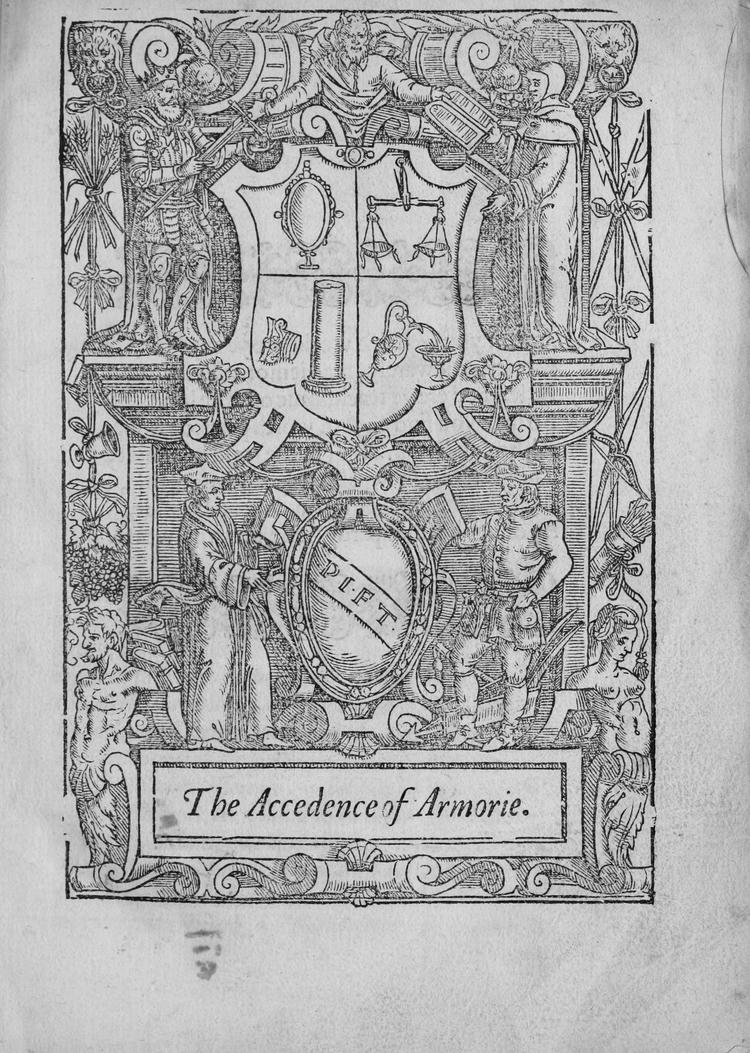
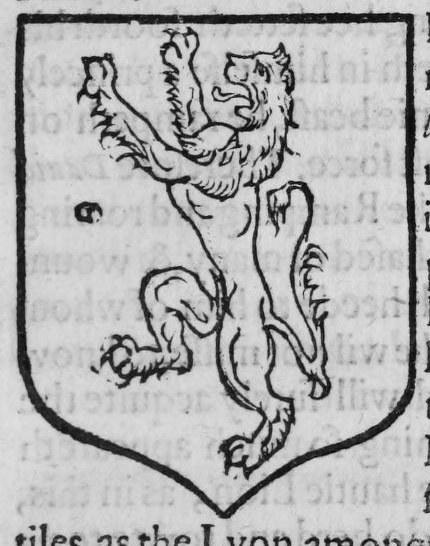
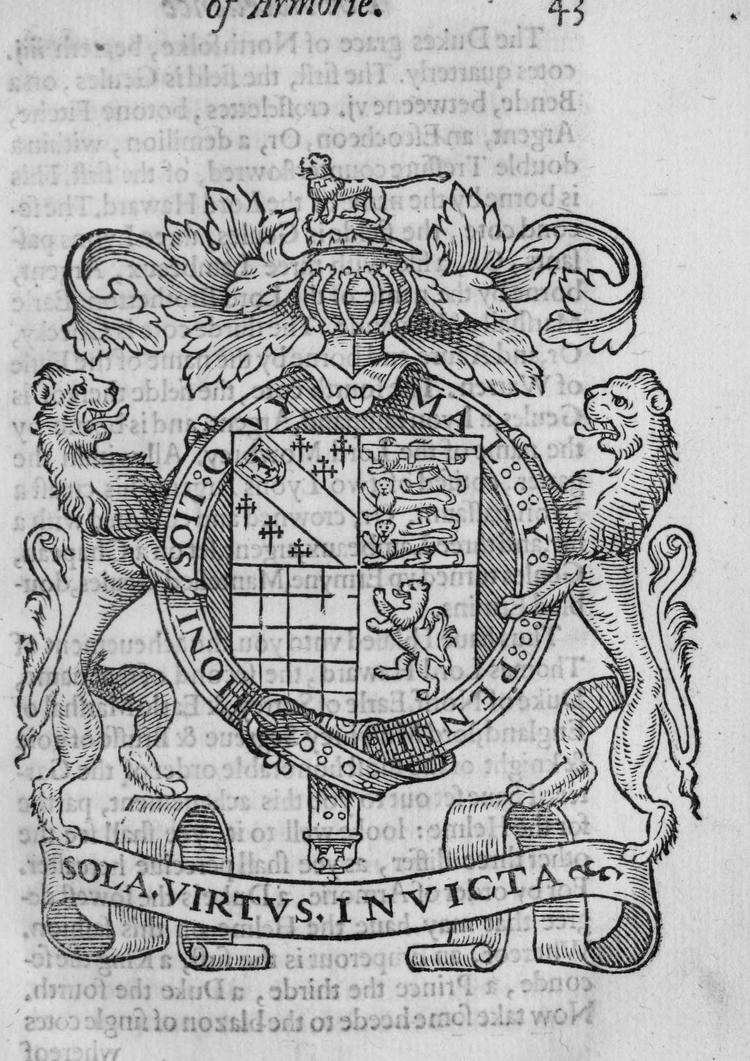
The edition is illustrated throughout, and reproducing the illustrations was its own task. There are 308 woodcuts: coats of arms, the four armorial achievements, the folded plate, and the allegorical title border. They are cropped from the scan and placed inline where the text refers to them, each with a description. Again, I used AI to handle this task. It did a reasonable job of identifying the right images, transforming them, and placing them in the text.
Three of them would not cooperate. The billets and gouttes shields on fol. 93v never printed in the Getty copy, and the buckles shield on fol. 95v printed only faintly. I could have left them out or reproduced the smudge, but a missing image in a treatise about blazon is a real loss. Instead I took clean impressions of the same three woodcuts from the 1576 edition, The Accedens of Armory (STC 15391), which survives in a scan of its own.
The woodblocks could be reused from one edition to the next, so a different printing is often the best double-check for an image that came out badly in the copy you happen to have. It felt odd to repair a 1597 book with pictures from a 1576 one, but they came from the same blocks, so…
Where it stands
The 1597 edition is complete and proofread, mostly. The 1562 first edition is recorded as a bibliographic entry for now, without a transcription, and the 1612 printing is described in the sources as a distinct recension, “newly corrected and augmented.” I don’t think I’ll be attempting to transcribe either of those separately, though.
I’m pleased with it, and not just because it’s finally finished. The book is legible now in a form that can be read, quoted, and checked against the scan, which is the whole point of putting a primary source on a personal site. The transcription is not perfect, and I’ve tried to be honest in the editorial notes about where it is uncertain. If you spot a misreading, I would like to hear about it.
For now, I hope you find this useful. I’m probably going to take a break from heraldry primary source projects for a bit and focus on Iron Arachne. Well, except for the book on mon that I’m reading, but that’s just for fun.