I wanted to make a region and then give it a person who lived there: a Dungeon Crawl Classics character with ties to that place. Iron Arachne could generate both, but they were stranded on separate pages. There wasn’t a good way to treat them as pieces of the same world.
That’s what the Iron Arachne Workshop changes. It’s out now, and it gives you a place to bring generator results together and build them into a setting or campaign.
From a pile of tools to a world
Iron Arachne has accumulated a lot of useful generators over the years. You can make planets, cultures, characters, regions, and plenty more. But until now, most of those tools existed on their own. You could generate a collection of interesting things, but the site didn’t do much to help you connect them.
My goal for Iron Arachne is to help people build coherent campaign worlds, not just produce a pile of unrelated results. Personally, the site had started to feel scattershot to me: a bunch of toys without a reason to exist together. I wanted to make something, keep it, and use it as the starting point for the next thing.
Welcome to the Workshop
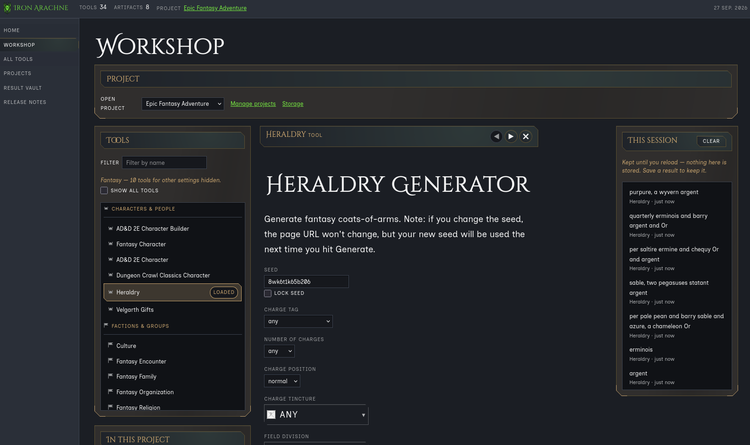
A Workshop project is a home for one campaign, setting, or world. Think of it as a workbench: open generators and editors as tools, make something, and save the results you want to keep to the project. You can come back to them later, edit them, or use them in other tools.
Say you start with a region. You can save it to your project, then use it while you make a settlement or a character who lives there. The pieces of the setting stay together instead of vanishing into a trail of separate generator pages.
To get started, create a project and open a tool from the Workshop. Generate something and it will appear in the current session. Save the results you want to keep to your project; otherwise, session results disappear when you reload. From the project, you can reopen a saved result, edit it, or use it in another tool. You can also turn the whole project into a PDF, handy for sharing or keeping a copy outside your browser.
Projects are stored in your browser, not in an online account, so export a backup if you want to move your work to another browser or device (or just want a safety copy). † If you clear this browser’s site data before exporting a backup, the project will be lost. ↩ You can import that backup later. And if you prefer the old way, the individual generator pages are still available, just as before.
Building the Workshop
This update changed how I approached development, too. In the past, I often started coding and saw what shape a feature took as I went. For the Workshop, I tried to work design-first: figure out what the experience should be, decide how the pieces fit together, and then build toward that.
Two early decisions shaped everything else: the local-storage approach † It’s important to me that Iron Arachne will survive for its users even after I’m gone and the site is no longer live. You’ll still be able to use it, though you might have to figure out how to run it yourself. ↩ and the panel-based interface. Generators and editors needed to feel like tools you can bring to the same workbench, not separate pages you have to keep jumping between. Keeping projects in the browser also let me avoid building accounts and a server-side database, though it does mean backing up your work is on you.
The visible interface was only part of the job. I had to migrate saved data from the old system, make saved results editable, let tools refer to one another’s results, and add safeguards around browser storage. Then there was the less glamorous but essential work of checking everything on mobile and across browsers.
Iron Arachne now has 6,438 unit tests and 657 end-to-end tests. That’s a lot of tests. A lot. They helped me change a bunch of connected parts without relying on memory and manual checks alone. And yes, AI wrote most of them.
AI in the development process
This was also the first major Iron Arachne update where I used AI coding tools extensively. I started with OpenCode and Alibaba’s Qwen3.7 Plus, tried Claude after using it heavily at my day job, and eventually switched to OpenAI’s Codex when Claude’s output got too obtuse for me.
The boundary is important: Iron Arachne itself does not use AI to generate its results. These tools were part of my development process, not part of the product. The generators still work through rules and algorithms that I can inspect and shape.
Some AI-written prose did make its way into Iron Arachne while I was moving quickly, and I wasn’t happy with it. Generated text can sound plausible at a glance and still be vague, repetitive, or just plain bad. I’ve been replacing it with human-written text, and that cleanup is still ongoing.
The region map generator is a good example of why I can’t just trust the tools and walk away. I had an experimental prototype sitting in the codebase † I’ve been working on this region map generator for a long freaking time, like years. I kept trying things, deleting them, reworking them. It’s been kind of a nightmare. It was almost a personal white whale. That AI fixed all of the problems I was having in a matter of hours was a little… disheartening, maybe? But also relieving. ↩ . During a Claude-assisted pass, it ended up in a release without me noticing. I only caught it when I opened the region generator and found a hideous map staring back at me.
I used Codex to help repair and finish the generator, then chose to include it in the release on purpose. The map tool is there now because I decided it was ready, not because an unfinished prototype slipped through. AI tools can help me move faster, but I still have to review the work, decide what ships, and take responsibility for it. Sometimes that means a (very) firm veto.
The Workshop is a big change to how you can use Iron Arachne: you can keep a world’s pieces together, revise them, and build on what you’ve already made. Give it a try at Iron Arachne, and let me know what you build with it. I’ve started planning the next big update, too. I can’t share much about it yet, but the Workshop gives me a much better foundation to build on.